
Cost savings are at the forefront of any machine builder, systems integrator, and OEM’s mind when it comes to designing a machine, or line, that is both precise and practical. Behind the low price tag of a pneumatic cylinder is a commitment to regular, costly maintenance and high energy expenses to keep your system running, all while scheduling routine downtime and servicing.
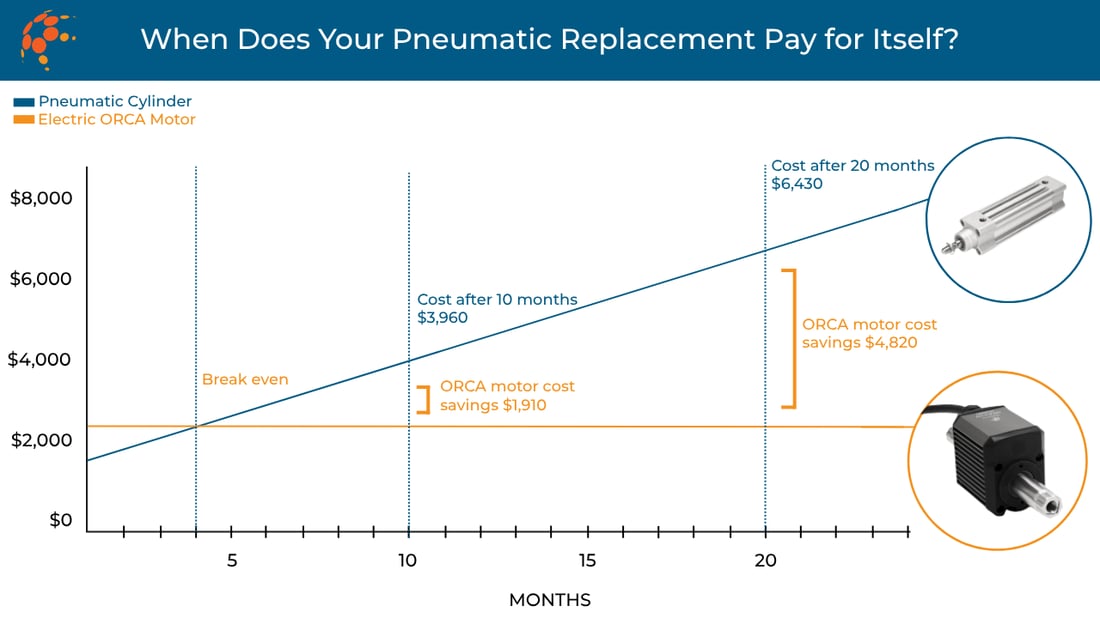
Pneumatics can be less expensive upfront than it's electric alternative, such as the ORCA motor, but they quickly reach parity with the electric motor’s initial price after just four months of operation. As pneumatic cylinder costs climb, the electric alternative remains financially consistent with little maintenance required and no scheduled downtime. Replacing pneumatic systems will pay for itself in less than four months, and the savings will continue to multiply as the system operates year over year. Learn more about pneumatic retrofit considerations here; the trade offs with repeatability, precision, maintenance, TCO, compliance, noise, etc.
| 20-30% Air Loss | $2,150 Annual Maintenance | 90% Energy Input Loss | 7-8 Horsepower Electrical Energy Required |
| Typical loss with standard servicing | Leaks represent a continuous operating cost whether the machine is cycling or not | During production and distribution of compressed air systems | To operate a standard pneumatic cylinder with 1 horsepower of mechanical output |
Pneumatic Cylinder Components Cost Chart
|
Component |
Function |
Cost |
|
Air FRL = filter, regulator, lubricator |
To condition and prepare compressed air before it enters the downstream pneumatic components, specifically protecting the precision-machined internal parts of a directional control valve and a pneumatic cylinder. |
Economy/Miniature Units: $60-$90
Heavy Duty High-Flow Units: $180-$350 |
|
Compressor |
An air compressor is a mechanical device that converts power into potential energy by forcing atmospheric air into a smaller volume. |
Continuous Duty: $2,742-$3750 |
|
Pressure/Control Switch |
Electromechanical device that uses an electrical signal to physically route the compressed air into the pneumatic cylinder, dictating exactly when and how fast the cylinder extends or retracts. |
Standard Industrial Solenoid Valve: $48-$88
Heavy-Duty High-Flow Solenoid Valve: $120-$165 |
|
Pneumatic Cylinder |
A specific type of linear actuator that converts the energy of compressed air into mechanical force and motion. |
Low end: $25-$80
Median: $150-$300
High End: $500-$1500 Heavy-duty (food processing or chemical plants) |
|
PLC |
Industrial-grade computer designed to automate manufacturing processes by continuously monitoring inputs from devices like sensors and switches. |
Low-End: $110-$175
Median: $250-$300
High-End: $350-$600+ |
|
Load Cell |
A specialized sensor or transducer that measures mechanical force - such as weight, tension, compression, or pressure - and converts it into a measurable electrical signal. |
Low-end: $120-$175
Mid-Range: $300-$600
High-End: $1200-$2500+ |
Prices above are represented in USD. Prices are referenced from components available on McMaster-Carr.
Where Pneumatic Cylinders Burn Money
Pneumatic systems start accumulating costs on the first day of their installation. Industrial lines operate for long hours, often continuously without interruption. This puts strain on the components required to keep an air system pressurized under constant cycles, turning pneumatic systems maintenance into a high-cost regular expenditure.
The High Cost of Generating Compressed Air
Compressed air is inherently inefficient. To produce a single horsepower of mechanical work, a compressed air system requires between 7 to 8 horsepower of electrical input. Of that input, four-fifths of the energy is converted directly into waste heat. Even more energy is consumed by auxiliary cooling equipment just to keep the system within operating temperature limits.
For example, a typical compressed air system running a standard 2,250-hour shift will consume roughly $1,750 in electricity just to deliver 10 horsepower of effective force. As the required force and horsepower scale up, these ongoing expenses quickly skyrocket into the tens of thousands of dollars. Ultimately, because more force demands more volume, every single actuator stroke carries a direct financial cost.
|
Approximate Annual Compressed Air Electricity Cost |
|||
|
1 Shift (2,250 Hours) |
2 Shifts (4,250 Hours) |
3 Shifts (8,400 Hours) |
|
|
10 HP |
$1,720 |
$3,250 |
$6,430 |
|
15 HP |
$2,580 |
$4,880 |
$9,640 |
|
25 HP |
$4,300 |
$8,130 |
$16,060 |
|
50 HP |
$8,600 |
$17,260 |
$32,130 |
|
100 HP |
$17,120 |
$32,330 |
$63,900 |
The above figures are referenced from: Natural Resources Canada Energy Efficiency Guide.
Maintenance & Leak Losses Increase Pneumatics Operating Costs
It is expected that a compressed air system will lose 20-30% of air due to leaks throughout it’s lifetime. Fittings loosen, tubing ages, and seals wear. A single ⅜” (9.5mm) leak in a standard industrial compressed air network can vent enough volume to cost a machine operator tens of thousands of dollars annually.
Pneumatic cylinders use a network of interconnected components that work together to create motion. Each of these components must be individually maintained and replaced, meaning routine downtime and replacement parts. Solenoid valves, FRL’s, and compressors must be maintained individually and as part of the entire system. Beyond component maintenance, compressed air systems cost operators planned downtime to service parts and do predictive maintenance.
How Downtime Increases the Total Cost of Pneumatic Systems
Compressed air systems require monthly shutdowns for preventative inspections to check for hidden air leaks before they escalate. Because a pneumatic system relies on a vast web of distributed components, diagnosing the root cause of a pressure drop or failure point is notoriously lengthy and expensive. When an unexpected fault occurs production comes to a grinding halt.
If a system suffers from intermittent performance issues, production lines can be disrupted for hours, or days, before the faulty seal or sticking valve is finally isolated and replaced. This downtime can be very costly. For example, in a laminated veneer lumber facility, pneumatic cylinder downtime cost up to $30,000 an hour. Across typical industrial applications, pneumatic disruptions average 25 hours of annual downtime, quietly draining tens of thousands of dollars from the bottom line in lost production capacity alone.
Cost Comparison Case Study: High-Speed Packaging Line
To understand how these operational costs scale under real factory floor conditions, consider a cost comparison modelled around a high-speed packaging conveyor ejector designed to divert defective or mislabelled boxes off a main production line.
|
Application Parameters |
|
|
Stroke Length |
175 mm Standard 7-inch usable stroke on ORCA-6-24V electric linear motor Standard 7-inch pneumatic cylinder |
|
Moving Mass |
3.5kg (the typical combined weight of the machine’s pusher paddle, mounting block, and the product box being accelerated) |
|
Cycles Per Minute |
80 CPM |
|
Operating Hours Per Year |
6,000 (equivalent of running a 3-shift operation, 24 hours a day, 5 days a week, for 50 weeks a year) |
|
Electricity Cost: |
$0.12/kWh |
|
Required Force |
150 N (roughly 35lbs) |
|
Pneumatic Pressure |
90 PSI (6.2 bar) |
|
Pneumatic Cylinder Size |
25 mm |
|
Compressor Efficiency |
0.35 |
|
Maintenance Hours Per Year |
Pneumatic cylinder: 15 hours (allocated for tracking down air line leaks, lubricating seals, clearing moisture traps, and replacing worn-out cylinder O-rings) ORCA motor: 0.5 hours (virtually zero: direct-drive linear motors have no internal gears, fluids, or seals, requiring only a brief visual wipe down of the guide bushings annually) |
|
Downtime Cost Per Hour |
$1,200/hour (realistic industrial average for a secondary packaging line where a stalled conveyer stops the upstream process). |
The operational difference map out explicitly in the comprehensive first-year ledger below:
First Year Total Cost of Ownership (TCO)
|
Initial Investment One-time Day-one Expenses |
|||
|
Phase & Cost Category |
Pneumatic Cylinder |
ORCA Motor |
Notes |
|
Actuator Upfront Cost |
$1,490 |
$2,490 |
Base hardware price |
|
Supporting Hardware |
$450 |
$350 |
Pneumatic: valves. FRL, tubing / ORCA: power supply & cables |
|
Installation & Set Up |
$400 |
$200 |
Pneumatic plumbing + wiring vs. simple mechanical + 1 cable |
|
Total Initial Investment |
$2,340 |
$3,040 |
|
|
Annual Operating Costs |
|||
|
Phase & Cost Category |
Pneumatics |
ORCA Motor |
Notes |
|
Energy Usage ($0.12/kWh) |
$2,964 |
$54 |
Continuous baseline power draw |
|
Maintenance Labour & Parts |
$750 |
$15 |
Pneumatic Cylinder: 15 hours labour ORCA Motor: 0.5 hours visual wipe + bushing replacement every few million cycles |
|
Unscheduled Downtime Risk |
$1,200 |
Virtually $0 |
Based on a single 1-hour line stall at $1,200/hr |
|
First-Year Total Cost of Ownership |
$7,254 |
$3,109 |
|
Direct-Drive Efficiency VS Compressed Air Complexity
An electrical linear motor can be more expensive up front, however the upfront hardware investment comprises 96% of the total electric system operating profile. Contrasted to compressed air systems, where the initial hardware represents a tiny fraction of what machine builders will ultimately pay over the first year of ownership.
With the pneumatic cylinder demanding a heavy $8,004.00 per year in ongoing baseline operations, energy expenditures act as a rigid monthly liability. This baseline budget doesn’t account for the chaotic expenses of unexpected air line system losses, synchronization lag, or sudden component breakdowns. When regular mechanical disruptions manifest, every hour of lost cycling can add up to as much as a $1,200 penalty in stalled factory throughput, cascading maintenance overhead, and emergency engineering labour.
 |
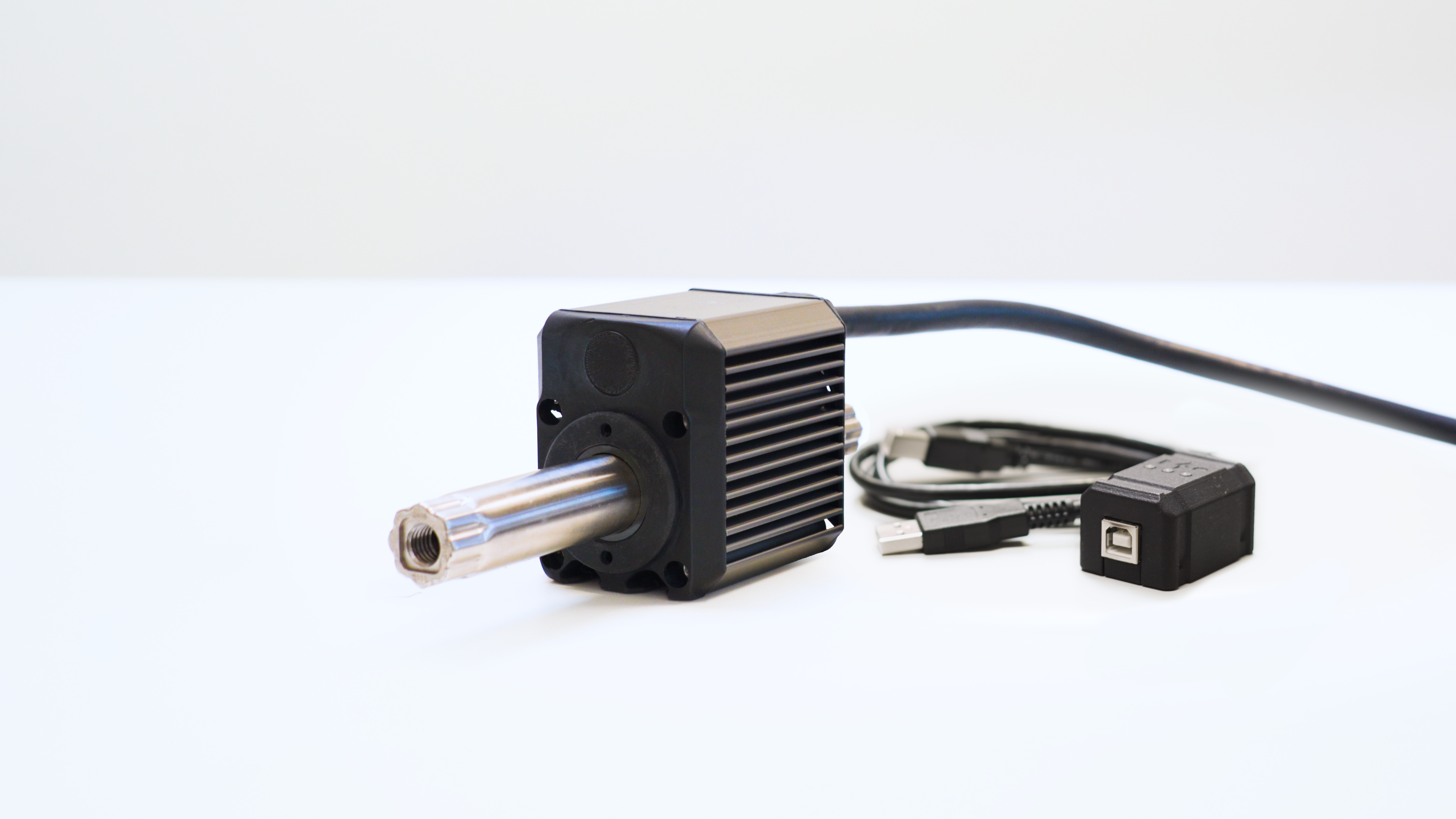 |
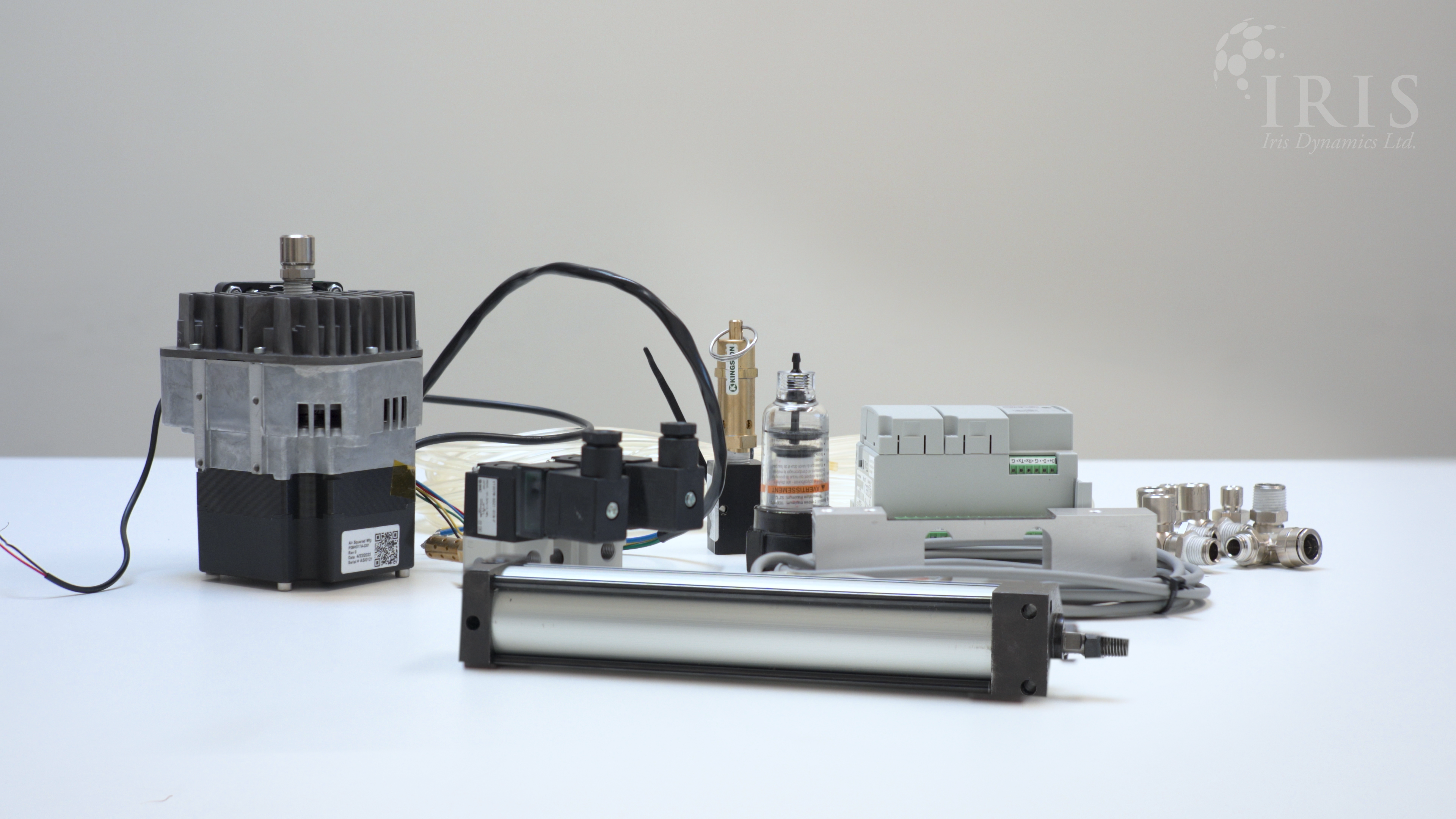
| Components required to operate a pneumatic cylinder | Components required to operate an electric ORCA motor |
The ORCA motor accomplishes the same mechanical workload at an absolute fraction of the overhead. Demanding less than $100 per year in total recurring expenses (~$8 per month), energy bills drop to near-zero because the direct-drive system pulls current only when physically executing a profile.
Because ORCA motors are fully integrated smart linear motors, the control electronics, position encoders, and drive components are sealed entirely within the structural housing itself. Machine builders can throw out routine tasks like line lubrication, dynamic seal replacement, and complete cylinder overhauls every few months. The factory floor noise pollution is neutralized - the solid-state motor operates as quietly as a whisper. The initial purchase price represents not just the cost of the actuator, but the cost of the components needed for it to achieve motion. The upfront price accounts for the vast majority of the ORCA motor’s total lifecycle cost, leaving no hidden expenses behind the numbers.
Final Thoughts
The upfront cost of the pneumatic cylinder itself makes up only 12% of the total cost of ownership a machine builder will pay over the course of the equipment’s operating lifespan. 76% of this total cost will be dedicated to electricity costs alone, and the remaining 12% to regular maintenance costs. Builders must also budget for approximately 90% of the energy input to be lost during the production and distribution stages in a compressed air system.
These costs, hidden behind an attractive, low-end, upfront price of a single pneumatic cylinder, don’t stop after year one. They will continue to accumulate at a consistent rate, accelerating as the machine experiences air leaks, component breakdowns, and routine part replacements. By the second year of operating a pneumatic cylinder system, the accumulated operational costs will have exceeded $5,000 – almost 300% more than the original upfront cost of the actuator itself.
.png?width=1100&height=163&name=CTA%20Banners%20for%20Blogs%20(1).png)