
.png?width=1100&height=220&name=Application%20Note%20Banner%20(2).png)
![DOWNLOAD TN260409 [PDF]](https://no-cache.hubspot.com/cta/default/9494162/00f510c4-e58c-4ebb-8002-d7f05d1c9ffa.png)
Available with firmware release 7.2.2/6.4.2. Contact Support to learn more.
ORCA ™ Series Smart Linear Motors can convert raw position commands into smooth, speed-limited motion automatically. Speed and acceleration control embed motion trajectory management directly in the motor, similar to Kinematic Mode, but with more flexibility. This enables safe, predictable motion while reducing system complexity and the expertise required to run the control system. ORCA motors’ position mode can be used either by continuously streaming position targets to a motor or by commanding a point-to-point move with velocity and acceleration constraints from an external controller.
When this Applies
- Position commands may change abruptly.
- The external controller lacks trajectory generation.
- Smooth and safe motion are required.
Benefits of Speed & Acceleration Control
- Prevents aggressive motion from abrupt commands.
- Reduces overshoot and mechanical stress.
- Allows tighter PID tuning without instability.
- Reduces reliance on sophisticated external trajectory generation.
How Speed & Acceleration Control Functions
ORCA motors accept a stream of position commands from the controlling system and use an internal position controller to modulate force to follow those position targets. When using speed and acceleration control, the motor is told:
- Where to go (the target position).
- How fast to move (velocity control).
- How quickly to start/stop (acceleration/deceleration control).
If position commands change rapidly, the resulting motion can be aggressive. Large or discontinuous position steps may cause rapid or violent actuator motion, overshoot of the command position, or undesirable mechanical or system behaviour. Avoiding these behaviours can be done by careful management of the commanded position trajectory by the external controller or by using PID tuning with aggressive damping. Alternatively, this can be done using the speed and acceleration control feature.
Motion Profile Behaviour
The motor maintains an internal position cursor that moves toward the latest commanded position. If the incoming command would exceed the configured limits, the cursor advances at the maximum allowable rate rather than jumping immediately to the new position.
| Velocity Control | Cursor moves toward the commanded position at a constant maximum speed. |
| Acceleration and Deceleration Control | Cursor follows a bounded motion trajectory with smooth ramp-up and ramp-down (S-curve style). |
The ORCA motor firmware provides the following registers for control:
| Speed Ctl | (POS_MAX_VEL 153) |
| Accel Ctl | (POS_MAX_ACCEL 154) |
| Decel Ctl | (POS_MAX_DECEL 155) |
As shown in Figure 1, these can be configured through IrisControls or by writing to the Modbus registers from an external controller.
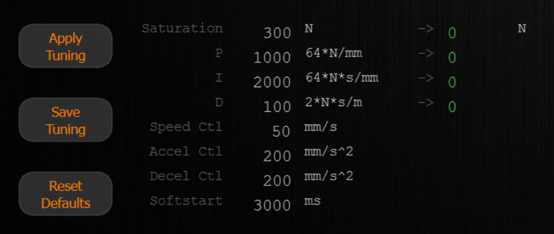
Figure 1. IrisControls tuning panel on position page.
IrisControls Notes:
-
Values of 0 are interpreted as infinite (no limiting).
- Limits can be adjusted while the motor is running and will take effect immediately.
- If the values are to persist through power cycling, the settings can be stored using the Save Tuning bit in CTRL_REG_2.
The position cursor value (the motor’s internal target position) is stored in motor registers, in addition to other position-related values. The motor ensures that the cursor moves at limited velocity and acceleration, generating smooth motion even for discontinuous commands.
Internal Cursor: The motor's limited internal target.
| POS_CURSOR 322 |
| POS_CURSOR_H 323 |
Position Command: Raw commands from an external controller.
| POS_CMD 30 |
| POS_CMD_H 31 |
Actual Shaft Position: Measured actuator position.
| SHAFT_POS_UM 342 |
| SHAFT_POSITION_H 343 |
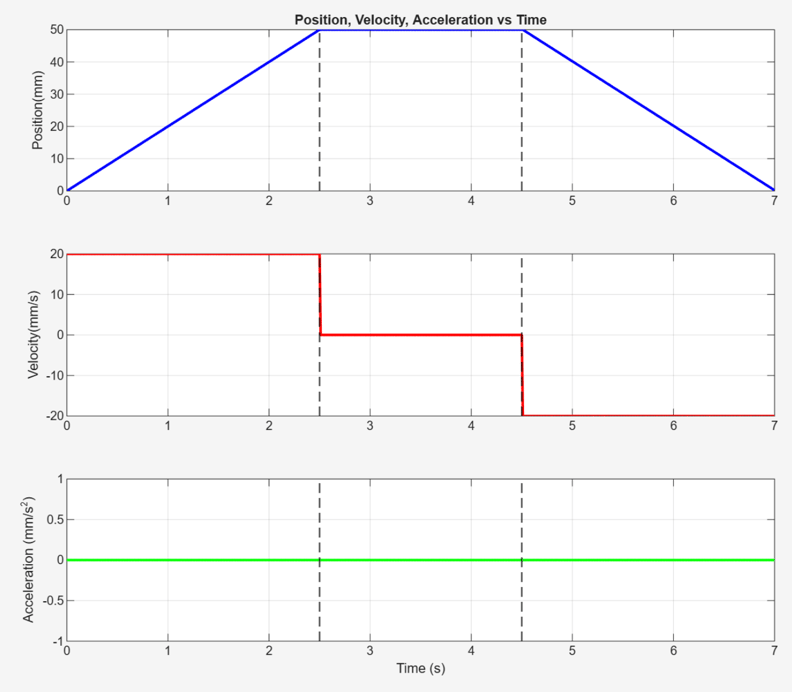
Figure 2. Position, velocity, acceleration vs time graph.
In Figure 2, the motor limits velocity to 20 mm/s, but applies no acceleration constraint. Velocity changes occur instantaneously when the direction of motion changes. This results in discontinuities in velocity and effectively infinite acceleration at transition points. While motion is bounded in speed, it may still be mechanically aggressive due to abrupt changes in acceleration.
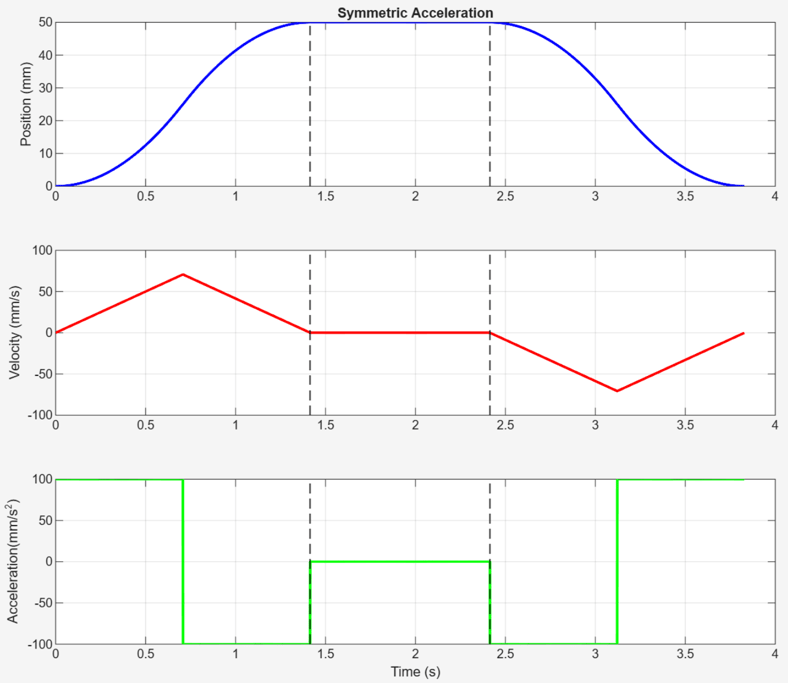
Figure 3. Symmetric acceleration graph,
In Figure 3, both acceleration and deceleration are limited to 100 mm/s², producing smooth velocity ramps. Velocity transitions are no longer instantaneous, eliminating discontinuities. The resulting motion profile is smooth and continuous, reducing mechanical stress and improving controllability. This produces a symmetric motion profile, where acceleration and deceleration behaviour are matched.
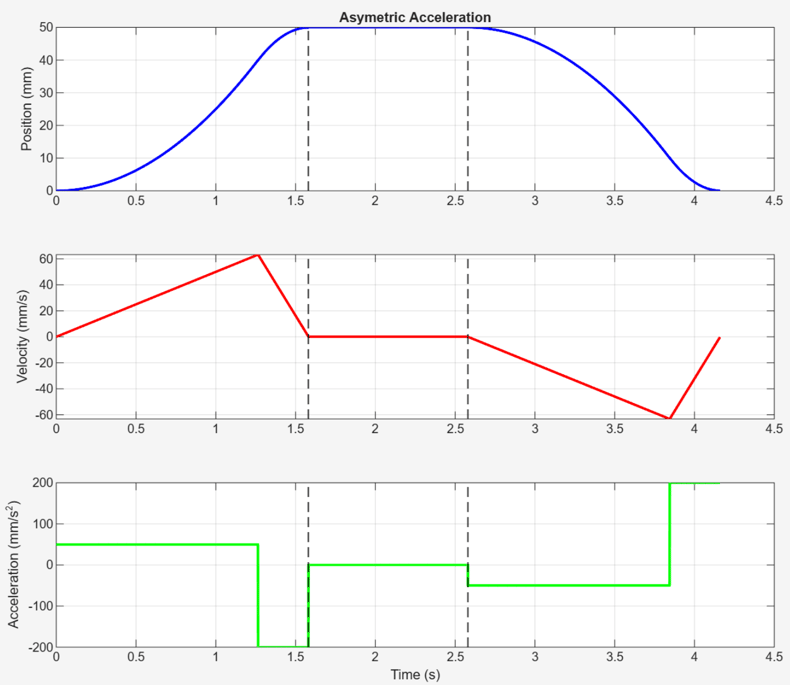
Figure 4. Asymmetric acceleration graph.
In Figure 4, acceleration and deceleration limits are independently configured, resulting in asymmetric motion behaviour. The motor accelerates more gradually (50 mm/s²) and decelerates more aggressively (200 mm/s²). This produces a skewed velocity profile, allowing tuning for application-specific requirements such as gentle starts and rapid stopping. Independent control of acceleration and deceleration enables improved handling of loads with directional or safety constraints.
Example Register Configuration
| Register | Value | Units | Description |
| POS_MAX_VEL | 50 | mm/s | Maximum velocity. |
| POS_MAX_ACCEL | 200 | mm/s2 | Maximum acceleration. |
| POS_MAX_DECEL | 200 | mm/s2 | Maximum deceleration. |
Behaviour
-
A sudden position command jump is received.
- The cursor moves toward the commanded position at 50 mm/s, ramping up at 200 mm/s².
- The actual shaft follows the cursor, producing smooth motion without overshoot.
Kinematic Mode Versus Speed & Acceleration Control
Kinematic mode has some similarity in behaviour to position mode with speed and acceleration control. Both embed motion trajectory management directly in the motor, enabling safe, predictable motion while reducing the complexity and expertise required in the external control system. Each has unique advantages that better suit different applications. A description of the applications that are best suited for each mode is provided in the table below. A description of the applications that are best suited for each mode in the table below.
| Kinematic Mode | Speed & Acceleration Control |
|
|