
This month in In Motion, we highlight a recent application story with POLAR Labs featuring a haptic-enabled 3DoF rehabilitation cobot, powered by ORCA Motors. We share an Iris Tutorial showing users exactly how to operate your motor in Haptic Mode, to achieve spring simulation, damping, inertia and oscillations. Finally, we discuss low-latency and real-time response for precise responsive outputs without the complication of a rigid mechanical system.
Integrating a Haptic-Enabled Linear Motor in 3DoF Rehabilitation End-Effector Cobot || Application Story with POLAR Labs
.gif?width=1100&height=733&name=polar1%20(1).gif)
Polytechnique’s Laboratory for Assistive and Rehabilitation Technologies (POLAR) is advancing next-gen end-effector robots for neuromuscular rehabilitation. To build a 3DoF system, the team needed a compact actuator with high speed and stroke, without compromising safety. The ORCA-3-12V met all criteria, delivering 8.1 m/s speed, 101.6 mm stroke, and integrated sensing in a backdrivable design. This enabled responsive motion and real-time force feedback for a portable, effective therapy system suitable for both clinical and home use.
Operating Your Motor in Haptic Mode || Ideal for Simulating Springs, Damping, Inertia & Oscillations
.png?width=1100&height=619&name=Iris%20Tutorials%20YouTube%20Thumbnail%20(8).png)
Haptic Mode is ideal for applications that simulate real-world physical interactions such as springs, damping, inertia, or oscillations. It combines position, velocity, and force control to create responsive motion that mimics natural behaviours. This makes it well suited for mechanical testing, training simulators, and robotics. All effects are fully configurable, processed directly on the motor, and can even be layered to create unique and specialized profiles.
Low Latency and Real-Time Response in Smart Linear Motors || Precise Responsive Output, Without Rigid Mechanical Systems
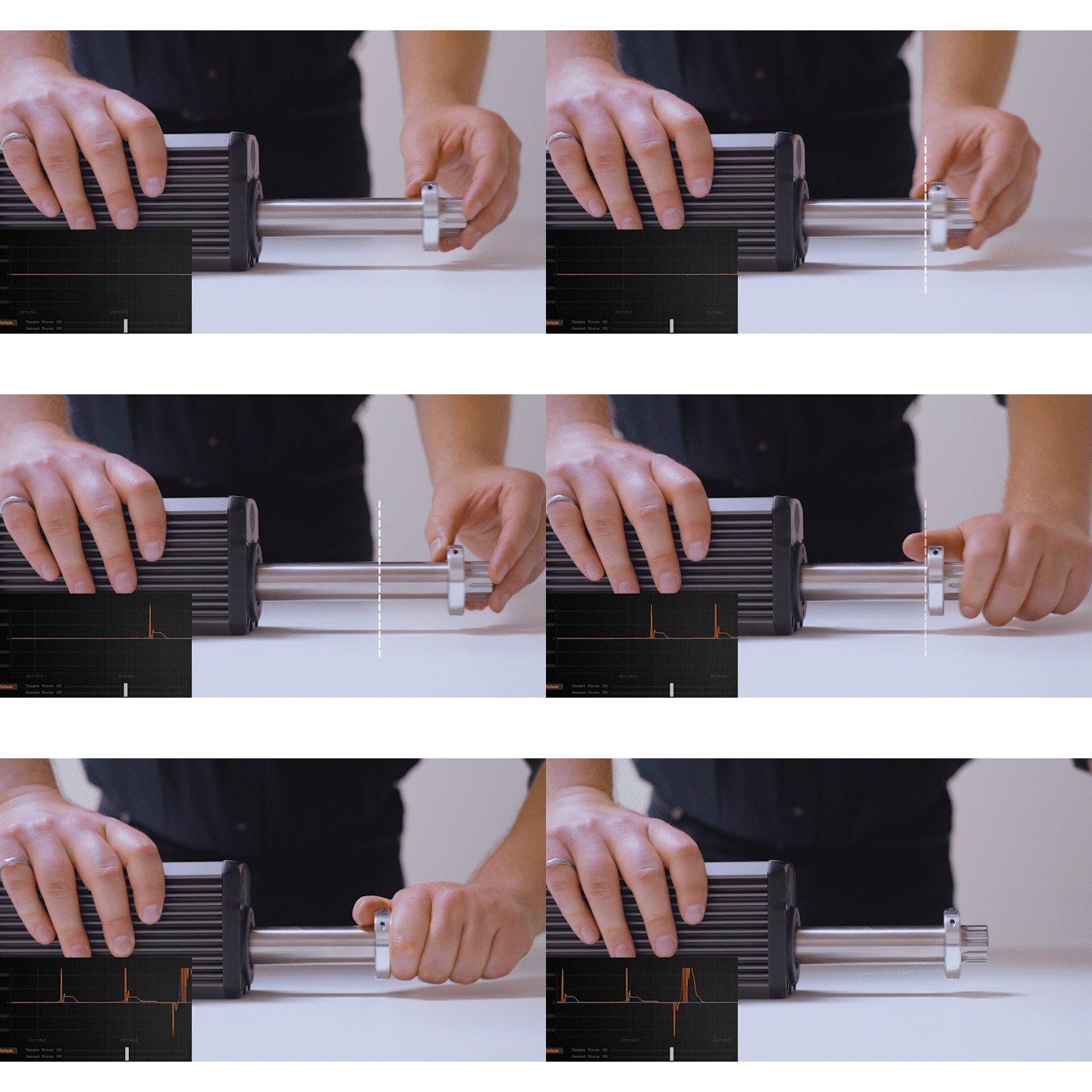
When systems lag, performance suffers. Fast, predictable, and consistent system response is essential in modern applications like robotics, automation, simulation, and human-machine interaction. Reducing the delay between an input and the system's response is critical in achieving high-precision control and reliable operation. This white paper explores how low latency and real-time response impacts your applications, outlining the benefits and how to attain it.
