
The University of North Carolina at Charlotte Application Story
Students involved in the Senior Industrial Design Program at the University of North Carolina at Charlotte worked on an automation project for an industrial manufacturer to improve its manual component quality-control process. The student group had nine months to design, test, and optimize an automated system for testing router bit weldments. The goal was to produce a consistent and efficient system that could deliver repeatable and accurate impact-testing results while minimizing downtime.
![[GIF] an ORCA™ Smart Linear Motor is shown pressing down on a routed bit inside a clear safety enclosure.](https://irisdynamics.com/hs-fs/hubfs/SummaryforIRIS1-ezgif.com-video-to-gif-converter.gif?width=800&height=450&name=SummaryforIRIS1-ezgif.com-video-to-gif-converter.gif)
|
Objective |
Iris Dynamics Solution |
Outcome |
|
Design a repeatable, force-controlled impact-testing system to replace manual hammer testing of router bit weldments. |
ORCA-3-12V Smart Linear Motor with magnetic force feedback, high repeatability, and minimal maintenance requirements. |
Developed a safe, automated, and repeatable testing process that eliminates operator variability, minimizes downtime, and can scale across the industrial manufacturer's production line. |


.png?width=90&height=82&name=Group%20152%20(2).png)
The Challenge: Manual Testing Introduces Operator Variability, Inconsistencies, and Downtime
The industrial manufacturer relies on rigorous quality control to ensure its router bits meet strict durability and reliability standards. A critical part of that process is testing the strength and adhesion of the welded carbide tips on each router bit before the products are released to customers.
The manufacturer's existing testing process involved striking each router bit manually with a hammer. The goal of the project was to automate this process. Because weld-integrity testing depends on the controlled and repeatable application of force, automation would improve the manufacturer's ability to generate standardized, defensible test data.
Solution: ORCA-3-12V Linear Motor with Magnetic Force Feedback, Closed-Loop Control, and High Repeatability
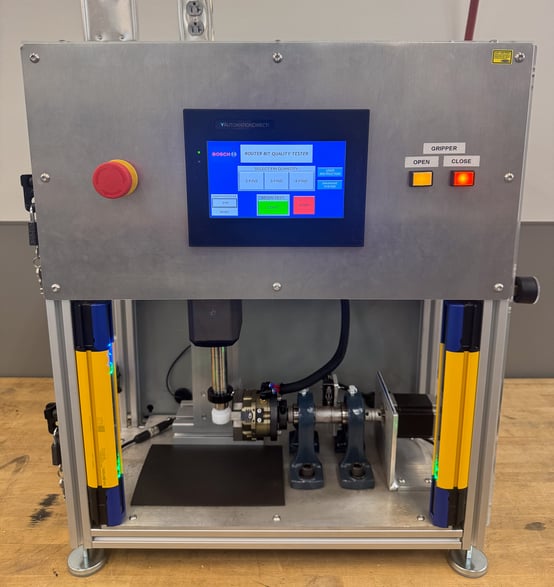
To replace the manual hammer-testing process, the University of North Carolina at Charlotte Senior Design team developed a hybrid electro-pneumatic testing system, built around the ORCA-3-12V linear motor.
The team required an actuation system that could be deployed quickly while delivering precise force, high repeatability, and minimal downtime. With only nine months to design, test, and deploy the system, the team could not afford the additional complexity and time required to source, integrate, and calibrate the external components typically required with a traditional linear actuator.
The all-in-one design of the ORCA™ Series Smart Linear Motors enabled rapid prototyping because the drivers, controllers, and sensors are tightly integrated within the motor housing. The ORCA- 3-12V provided a drop-in solution that combined actuation, force feedback, and motion control in a compact package. Its compact footprint also benefited the mechanical design, as space within the testing frame was limited.
Precise force control was critical to the integrity of the testing process. Although the ORCA-3-12V can reach a maximum force of 182 N, the system needed to deliver a reliable impact force to each router bit tip while maintaining consistent performance across repeated cycles. Generating sufficient force was not the challenge; applying consistent force with every strike was.
ORCA motors are inherently closed-loop devices. In a closed-loop system, force output is continuously monitored and adjusted in real time. The motor actively corrects its output to ensure the programmed force threshold is met during every cycle. Force is generated electromagnetically through controlled current in copper coils, while feedback is received as the magnetic shafts are loaded or moved. The system can therefore directly measure and regulate the force being applied, eliminating the need for external load cells or indirect force-estimation methods. Magnetic force feedback enables integrated force sensing and control, position sensing and control, fast response times, software connectivity, and low-voltage DC operation.
Because the system was intended for continuous operation, the team also required an actuation system with minimal maintenance requirements. Due to the ORCA motor's all-in-one architecture, its stainless steel shaft is its only moving component. The motor's primary maintenance requirement is the simple and cost-effective replacement of its Igus off-the-shelf bushings. Integrated force feedback also allowed the team to program and verify force directly through IrisControls and the PLC.
Technical Specifications
| Control Interface | IO SmartHub with PLC Integration |
| Configuration & Monitoring | IrisControls Software |
| Target Cycle Times | 40 Second Cycle Time for Two-Tip Bits |
| Validation Testing | 5,000 Cycles |
Integration
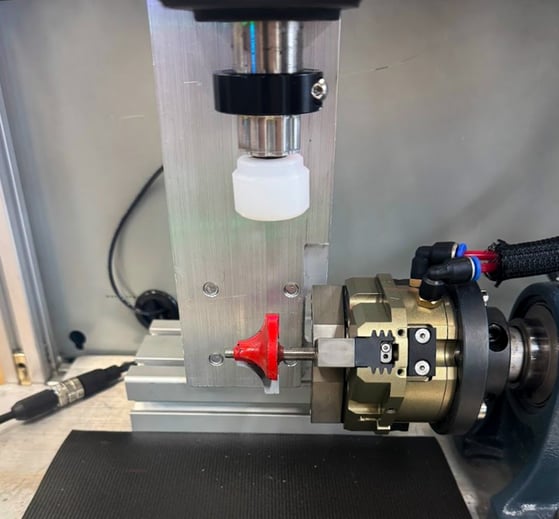
The final system is a hybrid electro-pneumatic test platform that integrates an ORCA motor with a stepper motor that provides rotary motion. The ORCA-3-12V is mounted vertically within a rigid frame and programmed to deliver controlled, repeatable strikes with measurable force to each router bit.
![[GIF] side view of a testing mechanism holding a red router bit in a motorized chuck below a vertical plunger](https://irisdynamics.com/hs-fs/hubfs/SummaryforIRIS-ezgif.com-crop.gif?width=414&height=399&name=SummaryforIRIS-ezgif.com-crop.gif)
Each router bit is secured in a pneumatic chuck, which firmly holds the shaft while allowing controlled rotation. Clearance bearings support the rotating assembly, maintaining alignment and minimizing friction to ensure consistent impact positioning. This mechanical support structure ensures that each strike is applied to the intended location with the repeatable geometry.
A stepper motor is integrated into the system to rotate the router bit shafter between impacts. This allows multiple carbide tips on a single bit to be tested sequentially without manual repositioning.
The structural frame was designed for durability and ease of maintenance. Components were arranged to remain accessible, allowing parts to be replaced quickly and minimizing downtime when switching between router bit types or servicing the system.
The control and impact parameters were configured using IrisControls software. The ORCA motor's motion was triggered by a PLC that sent signals to an I/O SmartHub. This architecture enabled programmable impact profiles through IrisControls, synchronized shaft rotation through the PLC, and direct force verification at the actuator level, creating a cohesive and automated testing workflow. While the system operated independently, IrisControls was used in parallel to monitor the ORCA motor's performance and the status of the I/O SmartHub in real time.
The I/O SmartHub enables an ORCA motor to be easily integrated with an existing PLC system. Pre-programmed motions can be initiated using a simple external trigger and coordinated with other components connected to the PLC.
Outcome
The completed router bit impact-testing system successfully automated the manual impact-testing process. By replacing manual strikes with closed-loop, force-controlled actuation, the system reduced operator effort and established a stable, repeatable testing process. Each impact delivered consistent, verified force, helping to ensure that every router bit met the industrial manufacturer's required quality standards. Testing ran smoothly and met the target cycle times for both ground and unground bits, producing reliable and defensible results across repeated trials.
By automating shaft rotation, the systems the system eliminated the need for operator intervention between tip tests, improving overall throughput. Multiple carbide tips could be evaluated sequentially without manual repositioning, streamlining the workflow and reducing handling time.
The router bit impact tester improved upon the industrial manufacturer's previous testing approach by providing a safer, more efficient, and more measurable method of evaluating weld strength and adhesion. The system met its design goals by maintaining production speed while improving test accuracy and automated data collection within a compact, low-maintenance platform.
-2.png?width=1720&height=255&name=CTA%20Banners%20for%20Blogs%20(3)-2.png)