
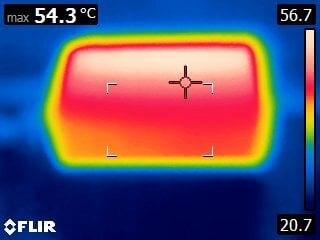
This paper examines the thermal behaviour of tubular linear motors and its impact on performance in advanced automation, robotics, and precision motion systems. It explains how the direct-drive architecture of linear motors, such as Iris Dynamics’ ORCA™ Series Smart Linear Motors, influences power dissipation, heating, and continuous force capability. By connecting electrical power, thermal limits, and force production, the paper provides practical intuition for predicting motor temperature under real-world load conditions. We outline strategies for reducing thermal load through motion design, duty cycling, and passive or active cooling, enabling engineers to size, integrate, and protect linear motors effectively in thermally constrained applications.
Definitions
| Steady State Temperature | The resultant motor temperature for a given power input that fluctuates no more than ±1°C over 30 minutes. |
| Continuous Power | The power dissipated by an ORCA motor when operated at steady state temperature for an indefinite period of time without overheating. |
| Continuous Force | The force output by an ORCA motor when operating at a Continuous Power setting. |
| Maximum Continuous Power | The power dissipated by an ORCA motor in a still air room at 20°C that results in the ORCA PCB reaching a steady state temperature of 70°C. |
| Maximum Power | Power dissipated by an ORCA motor when operated at its peak output, which is only sustainable for a short period of time. |
| Maximum Force | Force output by an ORCA motor when operating at Maximum Power. |
Linear motors generate force and motion by driving current through their windings, which generate magnetic fields that interact with permanent magnets in the shaft. The current passing through the windings generates heat that must be dissipated to prevent damage to any integrated electronics, to the magnetic shaft, and to the windings themselves. Understanding thermal performance and management allows a system designer to select the correct motor and configuration for an application, meet requirements, ensure reliability, and avoid excessive cost or size.
A natural starting point for developing intuition is understanding how generated force translates into electrical power consumption. Because linear motors behave fundamentally differently from rotary motors, prior instincts in this area often need to be recalibrated.
With this foundation, it is important to recognize that thermal constraints are shaped by multiple contributing factors. Maintaining sufficient operating margin requires understanding how each limit may be reached. Extended periods of high power draw, transient high-force events, elevated environmental temperatures, or impeded airflow can all contribute to excessive heating and potential thermal shutdown.
Finally, with a clear understanding of the motor’s thermal constraints and thermal response characteristics, designers can apply a range of mitigation strategies to achieve a robust and efficient system.
Force-Power Relationship
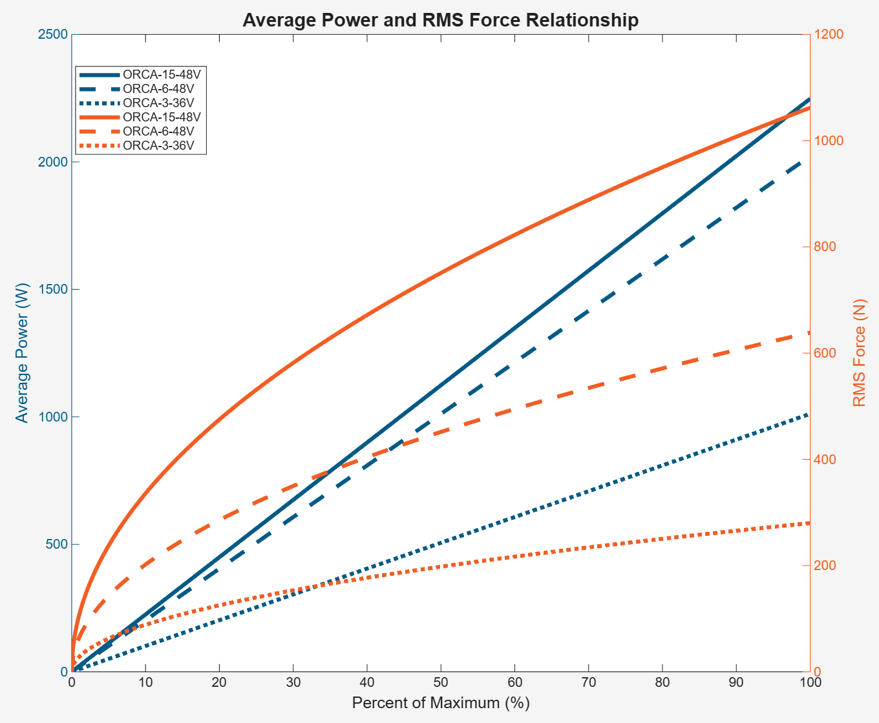
Building intuition for motor thermal behavior starts with understanding the square-law relationship between force and power. Motor force output is proportional to current, while resistive heating power scales with current squared. The result is Force² ∝ Power.
Therefore, small reductions in required motor force dramatically reduce heating: halving the force reduces power dissipation to one quarter, while doubling the force increases heating by a factor of four. Consequently, introducing mechanical advantages such as gears, pulleys, or leadscrews has a disproportionately large effect on thermal performance due to the exponential reduction in thermal power.
Thermal Limitations
Linear motors are typically thermally limited by several factors: integrated electronics, magnets in the shaft, copper windings, and safe operating temperatures for operators. The majority of the heat generated within a linear motor comes from the coil that drives the shaft, with the amount of heat directly proportional to the power input and the resulting force output.
As with other linear motors, ORCA motors exhibit long thermal time constants, on the order of minutes, due to their large thermal mass and relatively slow conduction paths from the windings to the housing and then to ambient air. This allows them to tolerate short periods of elevated force or power draw without immediate risk of overheating, because the windings have not yet transferred enough heat to raise the overall motor temperature or the temperature of the integrated electronics to dangerous levels. However, it also means that average power over a multi-minute interval is what ultimately determines long-term thermal stability.
Despite this long overall time constant, electric motors can experience rapid, localized heating in the windings during high power bursts. Copper coils react almost instantly to I heating, far faster than thermal energy can spread into the stator or chassis. This can cause windings or magnets to exceed safe temperature limits before the motor housing becomes noticeably warm. To prevent this, robust thermal protection is essential. Temperature sensors bonded directly to the coils provide the most accurate feedback, while an alternative is a motor driver that integrates a joule counter and uses a thermal model to estimate real-time winding temperature and enforce safe limits. While PCB-based temperature sensors can protect the motor from accidental overdriving, there is a meaningful time delay between power input to the coil and a measurable temperature increase on the PCB. Therefore, it is important to know what sustained input power will keep the motor below its thermal thresholds.
Effective thermal shedding is the final determinant of sustainable performance. Heat must flow from the windings to the stator, into the motor chassis, and then from the chassis to the environment. Ambient temperature, airflow, and enclosure design directly influence how efficiently the motor can reject heat. Moving air dramatically increases convective cooling compared to stagnant or trapped air, while attaching external heat sinks or conductive mounting structures to the motor chassis improves conductive and radiative heat transfer. Together, these environmental factors determine how quickly the motor can shed accumulated heat, and thus how much continuous or intermittent force it can safely deliver.
Maximum VS Continuous Power Draw
As motor windings generate power, they heat up and dissipate that heat through the chassis. The winding design, supply voltage, and electronics determine maximum instantaneous power, while the motor’s thermal limits set its continuous power capability. Between continuous and peak power, higher power can be used for limited periods as long as the average power remains below the continuous rating, which depends on cooling conditions.
For example, outputting 120 W for 60 percent of the time and 70 W for 40 percent of the time results in an average power of 100 W.
Motor Sizing
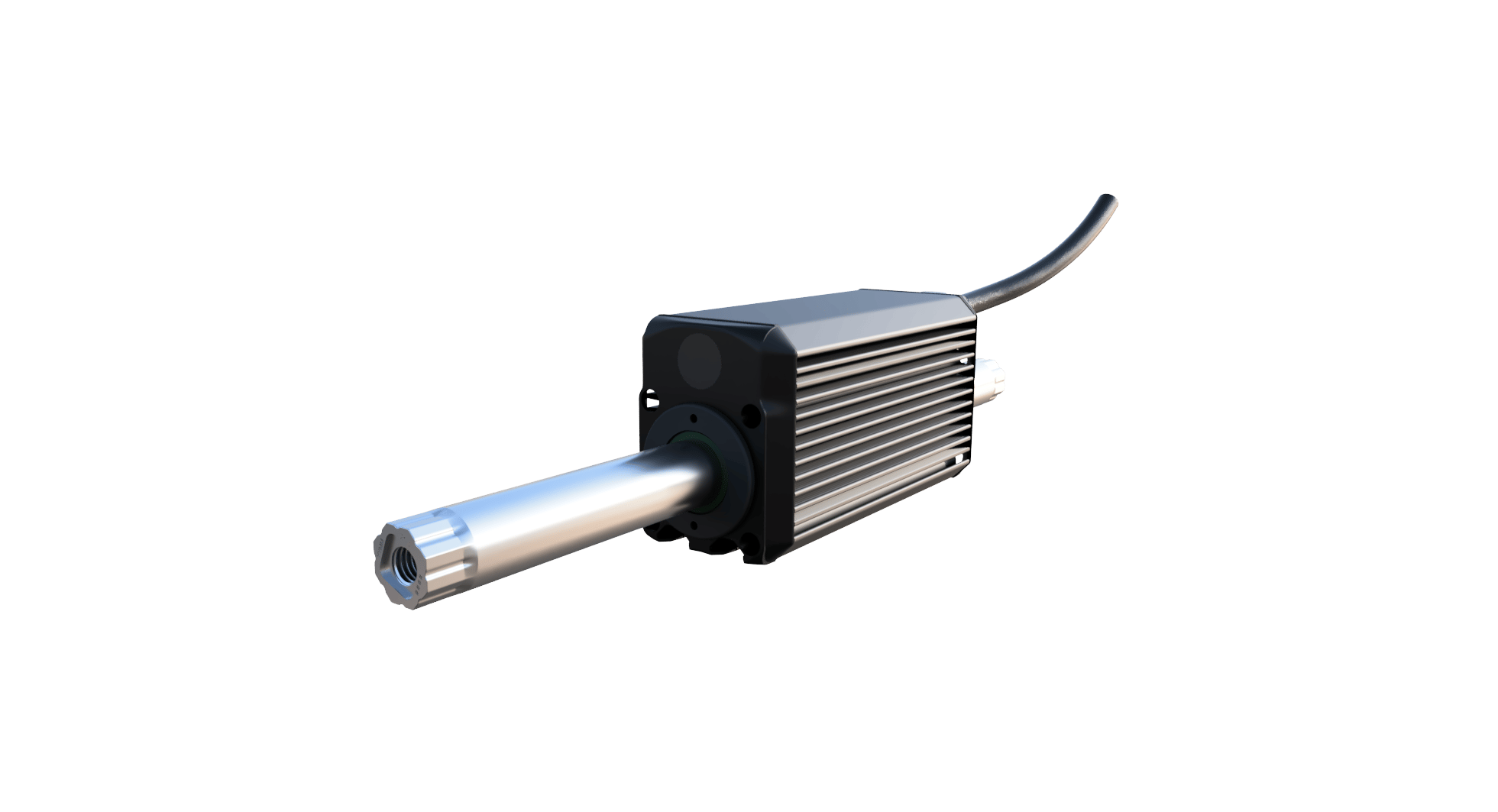
The chassis size of a linear motor affects both peak and continuous power draw. Larger motors have increased thermal capacity, improved thermal shedding capability, and higher force constants. Continuous force output is almost always thermally limited rather than electromagnetically limited.
.png?width=1961&height=1063&name=ORCA-3-Render%20(3).png) |
 |
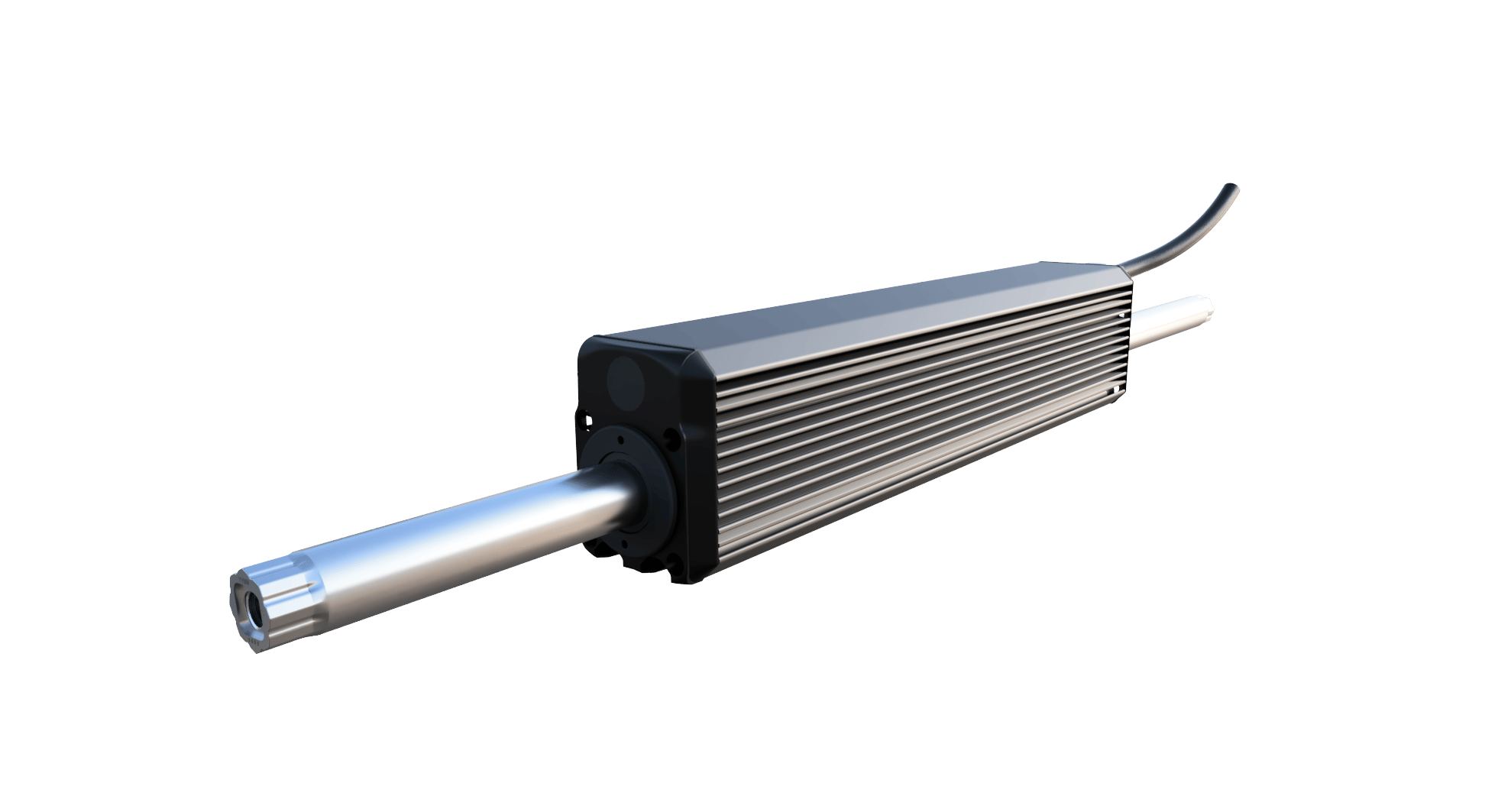 |
| ORCA-3 | ORCA-6 | ORCA-15 |
Thermal Capacity
The motor’s ability to absorb heat in the copper, epoxy, and chassis before reaching critical temperatures determines how long it can sustain elevated forces. A larger chassis provides greater thermal mass. For the same power input, a smaller motor will heat up much faster than a larger one. However, thermal capacity only buys time. Eventually, sustained I losses will saturate the system, making the motor’s long-term force rating dependent on average heating over its thermal time constant.
Time to temperature is based on power (P) and thermal capacity (Q = C⋅𝛥T).

The following graph compares the time various forces can be held using three different ORCA motors. The differences are due to the motors’ varying thermal masses and force constants. The graph assumes the time required to heat from 20°C to 70°C. ORCA motors have a thermal cutoff of 120°C for the coil temperature and 70°C for the PCB temperature.
.png?width=810&height=648&name=orcamotormaxloadholdingtime%20(1).png)
Thermal Shedding
The efficiency with which heat is transferred from the windings through the motor body and into the environment ultimately governs the continuous force rating. Motor housing surface area plays a major role in heat dissipation, with larger motors benefiting from a naturally greater surface area. A motor’s ability to shed heat is also highly sensitive to mounting, airflow, and ambient temperature.
Motor Force Constant
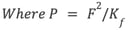
The relationship between force and electrical power can be expressed using a motor-specific constant Kf′ as F = Kf√P. The force constant of a motor refers to the efficiency of turning power into force, it is measured in newtons per square root Watts. Choosing a motor with a higher force constant will allow a motor to output more force for the same power draw. A larger motor typically has a larger Kf′ enabling it to produce more force for the same electrical power.
For example, if motors A and B both have a thermal capacity of 150 W, but motor A has a force constant of 15 N/√W while motor B has a force constant of 12 N/√W, motor A will be able to produce a continuous force of 184 N but motor B will only be able to produce a continuous force of 147 N.
Winding resistance increases with temperature, so generating a given force requires the same current but results in more power loss from the relationship Ploss= I2R. As resistance climbs, the motor’s effective Kf′ drops, meaning it requires more power to generate the same force output and warms even faster.
This creates a thermal runaway: the hotter the motor becomes, the easier it is for it to get even hotter. Understanding these relationships is essential for actuator design, thermal protection strategy, and motor sizing decision.
Ambient Temperature
The ambient temperature can play an important role in choosing the linear motor best suited for an application. In some cases, such as operating in a hot factory environment or a confined space, the motor’s force must be derated due to elevated ambient temperature, and a larger motor than initially expected may be required. The following equation is a typical guideline for derating specified force at higher ambient temperatures.
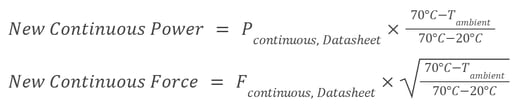
As the ambient temperature approaches the motor’s thermal limits, the amount of time the motor can operate at its maximum power decreases, eventually reaching a point where maximum power can only be achieved instantaneously because the temperature would immediately exceed the motor’s safe operating limit.
Mitigation
Decreasing Average Power
Effective thermal management of linear motors begins with strategies to reduce average power draw, since continuous heating is governed by RMS (root-mean-square) force rather than instantaneous peak force. Reducing RMS force can be achieved by decreasing accelerations, smoothing motion commands, reducing the duty cycle of holding forces, or adding mechanical advantage or spring/pneumatic assistance to the system.
Reducing Duty Cycle
Shortening the duration of high-force events or spacing them farther apart can significantly reduce average power draw and thermal load, even when peak forces remain unchanged. If instead of drawing maximum power continuously the motion includes rest periods, the motor can take advantage of its long thermal time constant and shed accumulated heat more effectively.
For example, consider a motor with a force constant of 15 N/√W. Its peak output force differs depending on duty cycle: 150 N when operating continuously, compared to 212 N at a 50 percent duty cycle.

%20(1).png?width=799&height=693&name=continuousoperatiosustainedforce%20on%20fan%20cooled%20ORCA%20motors%20(1)%20(1).png)
Decreasing Peak Force
Reducing peak force also reduces instantaneous current spikes that can cause rapid, localized coil heating before heat spreads through the motor body. Reducing peak force by half reduces power draw to one quarter.
Outputting 200 N with a force constant of 15 N/√W requires 178 W.
Outputting 180 N (90 percent of initial force) with 15 N/√W requires 144 W (80 percent of initial power).
Outputting 100 N (50 percent of initial force) with 15 N/√W requires 44 W (25 percent of initial power).
Pneumatic and Spring Support
Due to the control mechanisms in linear tubular motors, the use of springs or pneumatic support in conjunction with the motor provides the best features of both systems. The PID control loop of a linear motor will settle to provide only as much force as required to hold a position, meaning that the motor does not need to “know” anything about the force offset provided by the spring or pneumatic system in order to reduce its power consumption.
In other actuation systems, springs can introduce undesirable effects due to time- and temperature-related performance drift. With this class of linear motors, any force offset can be beneficial to the motor’s power consumption. Furthermore, the spring can be easily calibrated to still enable force sensing, as long as the motor is able to apply enough force on its own to fully compress or extend the spring.
Cooling
Air Flow
The ORCA series motors have a chassis designed with cooling fins that provide a large surface area for heat dissipation. Airflow across the chassis has a significant effect on motor cooling performance. Airflow can come in the form of fans mounted to the side of the chassis (link to technical note about fan mounting). Airflow is also occasionally provided in use cases where the motors are mounted on a moving vehicle or boat.
The effect of the fan cooling on a motor will increase with stator size as there is more surface area. A single fan can increase the continuous maximum power significantly, between about 3 times higher for smaller ORCA motors to up to 5 times higher for larger motors. Increasing this airflow can increase the continuous maximum power with diminishing returns. Important to note, though airflow will help if the motor is in an enclosed space, the ambient temperature may increase over time, reducing the effective cooling over time.
Mounting the motor such that all sides of the motor are exposed allows for uniform convective cooling across the entire chassis. In contrast, mounting configuration where one or more sides are obstructed or enclosed limits airflow contact and reduces effective surface area for cooling. Explore our Iris Tutorial on mounting your ORCA motor.
Water Cooling
ORCA motors are IP68 rated. In the same way that the cooling fins provide a large surface area for forced-air cooling, they also provide a large surface area for water cooling. A water spray, constant overflow, or even fully submerging the motor underwater can have a substantial positive effect on thermal performance.
Final Thoughts
Effective thermal management is central to realizing the full performance potential of tubular linear motors in demanding automation and motion-control environments. By understanding how force, power, and temperature interact, designers can better anticipate thermal limits and make informed decisions about motor sizing, duty cycling, mechanical advantage, and cooling approaches. The strategies outlined in this paper demonstrate that thoughtful system design can significantly extend continuous force capability, prevent over-temperature events, and improve long-term reliability. With proper modelling and integration of thermal mitigation techniques, ORCA Series Smart Linear Motors can deliver robust, efficient performance even in thermally constrained applications.
-1.png?width=1100&height=163&name=CTA%20Banners%20for%20Blogs%20(2)-1.png)