
ACS Composite Systems Application Story
ACS Composite Systems is a Canadian manufacturer of ACM panels, flashing products, and thermal clips. Its raw materials are shipped to its local manufacturing facility, where the company's team of experts and journeypersons fabricates the products in-house. More than 720,000 thermal clips are cut and bent at the facility each year.
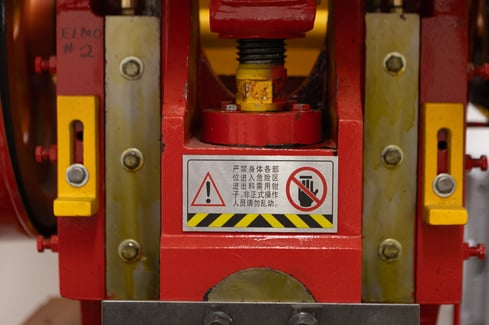
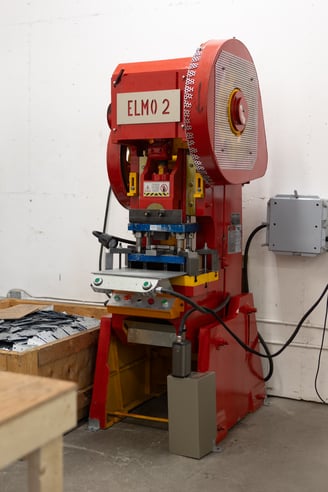
When demand for thermal clips increased, ACS purchased new metal presses to streamline production. The punch press machines came in bright red, green, and yellow colours, and each is cleverly named after a Sesame Street character. The red metal press, named Elmo, produces approximately 33% of ACS's annual thermal clip output. The green metal press, named Kermit, also contributes significantly to overall output. However, manually operating the foot-pedal press presented a serious safety and repeatability challenge.
|
Objective |
Iris Dynamics Solution |
Outcome |
|
Improve operator safety and production consistency by automating manual press actuation. |
Retrofit existing presses with ORCA-6-24V motors and IO SmartHubs™, replacing foot-pedal operation with dual-hand, simultaneous push-button activation and programmable motion. |
Reduced operator exposure to pinch and crush hazards while delivering consistent, repeatable press actuation across five machines. |


.png?width=90&height=82&name=Group%20152%20(2).png)
The Challenge: Improving Operator Safety in High Volume, Manual Press Operation
When ACS put their metal press machines into operation, they identified a safety and efficiency challenge with the existing setup. The machines required employees to manually guide each clip into position while simultaneously using a foot pedal to activate the press. This required operators to position their hands near the machine's lower die between operations, creating a pinching and crushing hazard if their hands were not fully removed before the press was activated. The manual nature of the process also meant that cycle times and production output could vary depending on each operator's pace and coordination, making it more difficult to maintain consistent and efficient thermal clip production.
ACS first explored modifications to the machines' existing electrical system. After determining that rewiring alone would not provide the functionality they needed, the team began evaluating electric actuators as a potential solution.
ORCA-6-24V Electric Linear Motor as an Ideal Fit
ACS retrofitted its Elmo and Kermit punch press machines with an ORCA-6-24V motor and an IO SmartHub™ to automate actuation of the existing foot pedal. With native force control, ORCA motors are well suited for human-machine interaction and for automation tasks traditionally performed by human operators, where responsive, controlled motion is essential.
Safe Human Machine Interaction
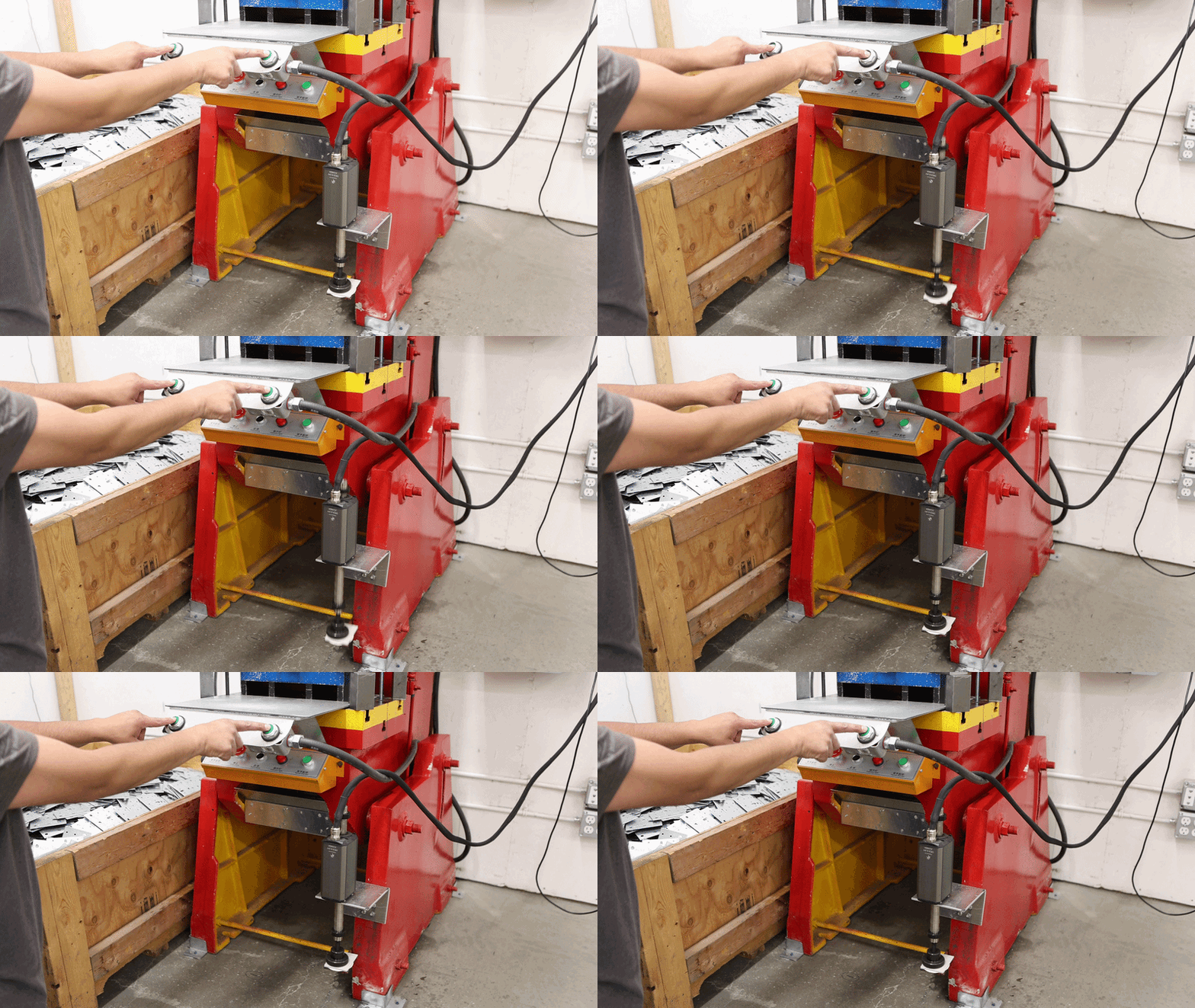
 By integrating an ORCA-6-24V motor into the Elmo press, ACS replaced manual foot-pedal operation with a two-hand control system. Requiring both controls to be actuated simultaneously to initiate the press cycle removes the operator's hands from the dangerous area near the die during operation, "if it's safe and everybody's going home with all 10 digits, I love that" - Jesse Cruz, Operations Manager.
The ORCA motor provides programmable force and motion control, with mechanical compliance and backdrivability that allow it to respond predictably to unexpected resistance. When external forces are applied the motor can regulate its force yield. Programmable limits on force, speed, acceleration and travel replace the variability associated with an operator's strength, coordination and reaction time, reducing repetitive strain providing predictable responses to unexpected resistances.
Improved Process Repeatability
The ORCA motor's closed-loop control continuously monitors position and force, making real-time adjustments in response to changing loads or resistance. Preconfigured kinematic motion profiles stored on the motor define movement to a target shaft position over a specified period. The IO SmartHub's digital inputs trigger these preset motions, delivering consistent extend-and-retract cycles. Automated force and motion control reduces variability associated with the operator's technique, pace, and fatigue, while operating speed can be adjusted to suit production requirements.
Fully Integrated, Quick to Deploy & Simple to Install
 |
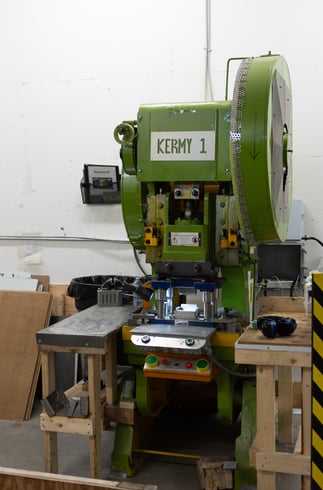 |
| Elmo Machine | Kermit Machine |
The ORCA motor combines the motor, controller, driver, and position and force sensing in a single housing and operates from a low-voltage DC power supply. Compared with systems that require separate external components, this integrated design reduces wiring, system complexity, mechanical points of failure, and simplifies installation and commissioning.
"The product, I think it's pretty straightforward. There is some technical stuff in there, it's probably really easy for a lot of people that are in this line of work that are using the ORCA motor. For me, it was a little more challenging just because I've never used it before. But now that I've seen the functionality, the Iris software, it's super simple. I have no issues with them moving forward. I know what I'm doing now. I feel like an expert, even though I'm not!"
-Jesse Cruz, Operations Manager
Technical Specifications
| Cycle Time | 1 cycle every 5 seconds |
| Stroke Length | 7 inches |
| Peak Actuation Force | Up to 426 N |
| Peak Actuator Speed | Up to 5.3 m/s |
| Operating Voltage | 24 VDC |
| Control Interface | IO SmartHub |
System Integration: A Simple & Scalable Retrofit Across Five Presses
 |
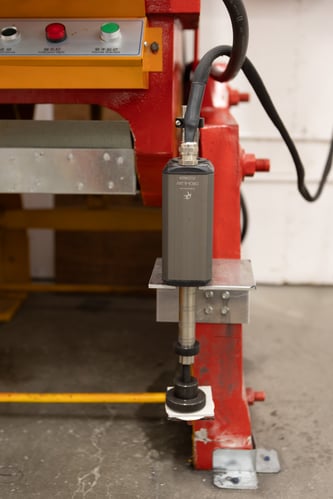 |
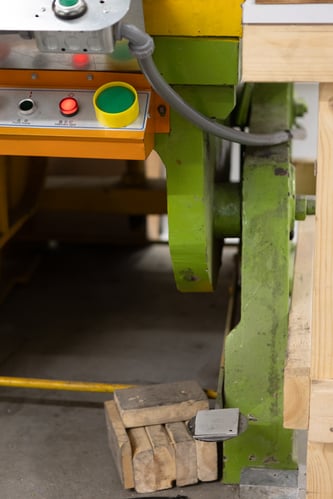
| Kermit Machine Before Retrofit | Elmo Machine After ORCA Motor Retrofit |
ACS mounted the ORCA motor to the Elmo and Kermit press machines using a simple aluminum adapter plate, positioning the motor to actuate the machine's existing foot pedal.
The two-hand controls send digital signals to the IO SmartHub, triggering the preset kinematic motion profiles stored on the ORCA motor to depress and release the pedal.
This drop-in approach allowed ACS to retain its existing machinery with minimal mechanical modifications, and easily scale the retrofit across its four other metal press machines, each equipped with an ORCA-6-24V and an IO SmartHub to mitigate safety risks on all equipment.
-2.png?width=1720&height=255&name=CTA%20Banners%20for%20Blogs%20(3)-2.png)