Electric linear motors are increasingly deployed in harsh environments, where exposure to dust, particulates, moisture, and water is a part of their normal operating conditions. From Autonomous Ground Vehicles (AGVs) to material handling to fully submerged marine applications, enclosure protection plays a critical role in maintaining reliable operation and long service life in applications requiring waterproof linear actuators. Ingress Protection (IP) ratings are a standardized method of describing how well a motor’s enclosure resists the entry of solid particulates and liquids.
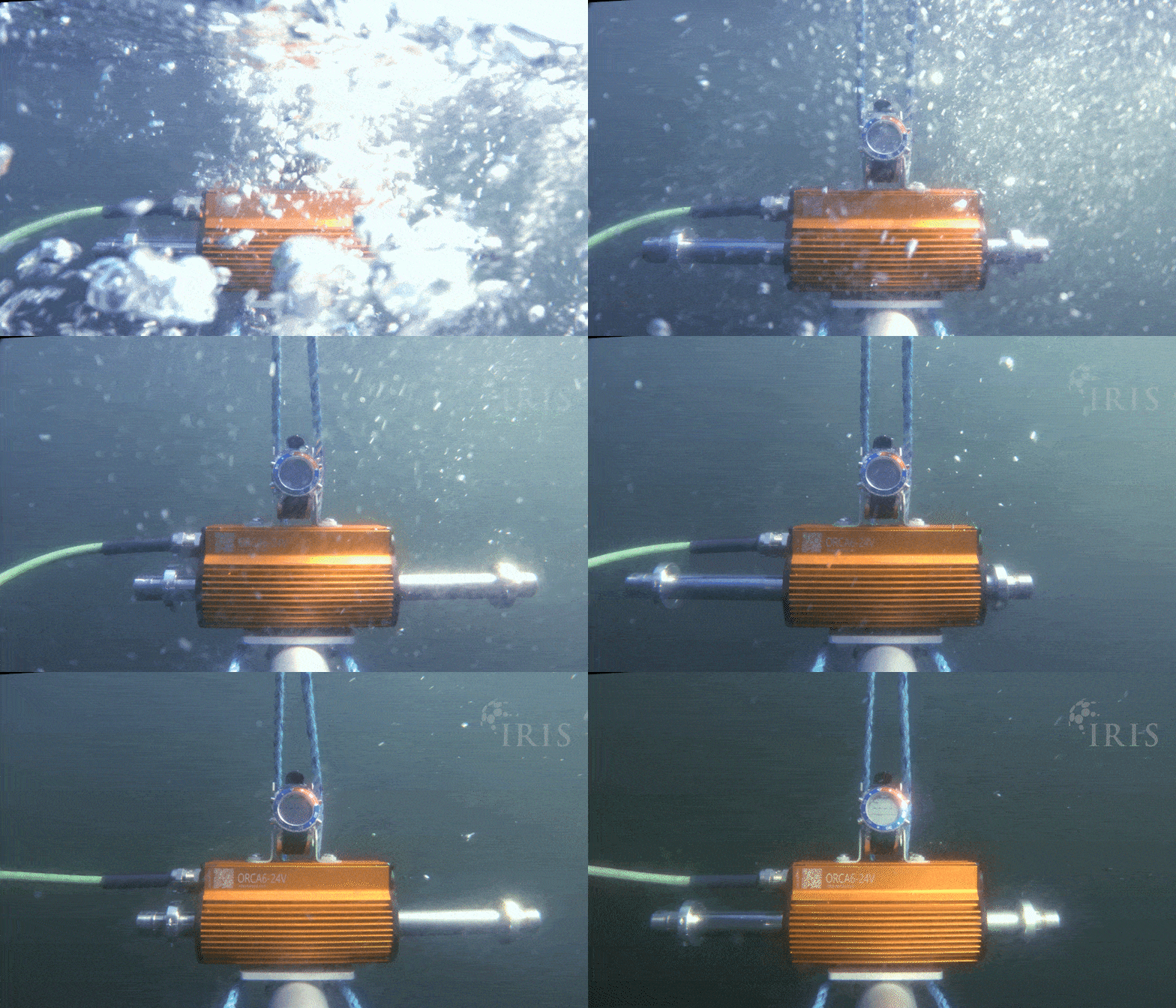
This guide explains how IP ratings are defined under IEC 60529, what the rating numerals represent, and how they apply to real-world applications.
What is an IP Rating
IP ratings are used to grade the resistance of an enclosure to solids and liquids. For electric linear motors, IP ratings help indicate how resistant a motor is to environmental exposure such as dust, saltwater spray, or full immersion.
IP ratings are defined by the IEC 60529 standard and are expressed as two digits following the letters “IP.” Each digit represents a different type of protection. The first digit refers to protection against solid objects, including dust, while the second digit refers to protection against liquids such as water.
It is important to note that an IP rating describes resistance to ingress only. It does not indicate overall motor performance, mechanical strength, or suitability for a specific application. Factors such as operating duty cycle, pressure, temperature, and motion under load are not covered by the IP rating system and must be considered separately.
.png?width=900&height=1165&name=IP%20Ratings%20Graphic%20(3).png)
What Do the Numbers Mean
First Digit
The first numeral in an IP rating refers to the degree of protection against solid foreign objects, whether it be dust, dirt, or sand, on a scale of 0 (no protection) to 6 (no ingress).
Second Digit
The second numeral rates the enclosure’s resistance to liquids on a scale from 0 (no protection) to 9 (no ingress with high-pressure hot water from different angles).
IP68 Ratings for Dust, Wet-Exposure, and Submersive Applications
IP5X/IP6X Dust-Intensive Applications || Material Handling Linear Motors
Certain manufacturing environments, such as agricultural manufacturing and bulk material handling, where harvesting, processing, and storage of materials produce fine organic dust, require actuation systems capable of sustaining prolonged exposure to dust and debris that accumulate over time. For dust-intensive applications, the first numeral of the IP rating is critical. IP5X indicates dust-protected enclosures, where limited dust ingress is permitted but not in quantities that interfere with operation or safety. IP6X is a dust-tight rating, where no ingress of dust occurs under specified test conditions. Without adequate sealing, particulate ingress can lead to increased friction, accelerated mechanical wear, and contamination of electrical components, ultimately shortening service life.
IP64-IP66 Wet-Exposure Applications || Autonomous Ground Vehicles & Outdoor Robotics Linear Motors
In wet-exposure environments, the distinction between a water-resistant linear actuator and a fully sealed IP-rated actuator becomes important for long-term reliability. Applications exposed to moisture, such as AGVs and outdoor robotic systems, require an actuation system that is resistant to direct contact with water that is somewhat continuous but not submerged. An AGV is exposed to rain, splashing water, condensation, and wind-driven moisture during normal operation. For wet-exposure use, IP64, IP65, and IP66 ratings are typically sufficient, depending on the intensity and frequency of water exposure. In outdoor robotic systems, moisture ingress often occurs at cable interfaces, dynamic seals, and enclosure joints, particularly when equipment is subjected to vibration and motion. Inadequate sealing at these interfaces results in corrosion and electrical faults over time. In mobile platforms, environmental sealing must be balanced against thermal management and system efficiency. Enclosures designed for wet exposure must prevent moisture ingress while still allowing effective heat dissipation during sustained operation. For low-voltage mobile platforms, the ORCA-3-12V provides a waterproof linear actuator 12 V option suitable for outdoor and wet-exposure applications.
IP68 Rated Sumbersive Applications || Marine & Underwater Linear Motors
Submersive applications such as Autonomous Underwater Vehicles (AUVs) and Remotely Operated Vehicles (ROVs) require a submersible linear motor to operate in a system below the waterline for extended periods of time. In these environments, the actuation system is exposed to continuous water contact and increasing hydrostatic pressure as depth increases. For submersible applications, IP68 linear motors are often required, where continuous immersion does not compromise enclosure integrity, with test depth and duration defined by the manufacturer. In subsea environments, selecting a marine linear motor rated IP68 for continuous immersion reduces the risk of ingress-related failure during long deployments. Without a true IP68-rated enclosure, water ingress can occur over time, leading to reduced insulation resistance, corrosion of internal components, and shortened service life. Electric linear motors are especially well suited to marine and underwater applications, where their precise control, high energy efficiency, and low-maintenance requirements enable reliable and repeatable performance in constrained and remote operating environments.
How are ORCA Motors Tested
ORCA™ Series Smart Linear Motors were tested at the QAI testing facility and passed IEC 60529 specification testing for second characteristic numeral 8, continuous immersion. During this test, the motor was operated while fully immersed in a 1 m–deep water tank for 72 hours, with functional testing performed before and after submersion. Conditioning tests were also conducted at QAI, where motors were placed in a 35 ± 2 °C chamber and tested in their normal operating orientation as well as alternate orientations. In addition, salt spray testing was performed with the motor installed in its normal operating position and exposed to a salt mist for 168 hours, followed by functional testing before and after exposure.
.png?width=1750&height=750&name=Linear%20Motor%20Reliability%20in%20Extreme%20Conditions%20WP%20Graphics%20(2).png)
Other Considerations
While an IP rating on the housing itself will ensure that the motor and electronics stay protected, it’s important to keep in mind that power and control signals must travel to and from the motor through cables, and those cables may need IP-rated terminations as well. Iris offers an IP-rated solution for cable termination in the event that the cable in your application cannot be routed to a protected area before connections are made.
Final Thoughts
IP ratings provide a useful baseline for evaluating how an electric linear motor can withstand exposure to dust and water, but they should not be viewed in isolation. Real-world performance depends on how closely test conditions align with the application, including orientation, motion profiles, duty cycle, and environmental intensity. Selecting the right IP rating is important in order to minimize system redesigns and ensure consistent, repeatable performance. ORCA motors, independently tested to IEC 60529 standards, are IP68-rated linear motors able to operate seamlessly in demanding environments where dust, dirt, and even continuous submersion are present.
.png?width=1100&height=163&name=CTA%20Banners%20for%20Blogs%20(8).png)