
Beyond Vibration: What Is Haptic Feedback?
Haptic effects have become an integral part of modern life: from a simple vibrotactile phone alert to a steering wheel vibrating when a driver drifts out of their lane, we experience tactile feedback every day. Haptic feedback extends far beyond basic vibration, with the ability to encompass the entire sense of touch, including active resistance, realistic surface textures, and dynamic physical forces.
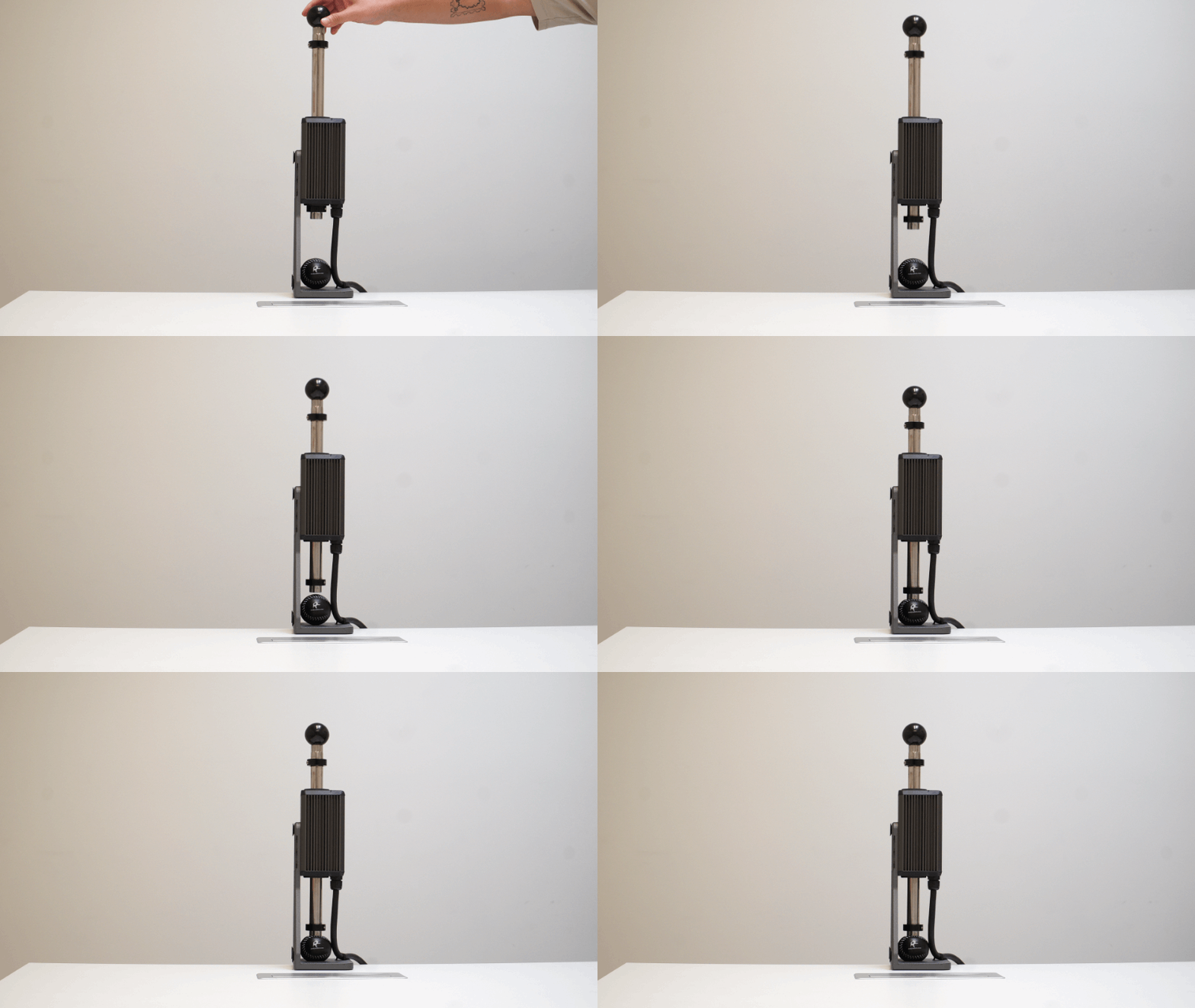
For engineers and machine builders, haptic feedback creates new opportunities to design more responsive, interactive systems. By integrating programmable force feedback into their applications, developers can simulate physical sensations such as resistance, vibration, and mechanical boundaries, giving users a more intuitive and realistic interaction with machines. High-fidelity haptic feedback gives engineers and machine builders precise control over how a system feels and responds. However, creating custom force-feedback systems has traditionally required complex mechanical linkages, external sensors, and low-level control algorithms. The ORCA™ Series Smart Linear Motor simplifies development by integrating sensing, motion control, and haptic feedback into a single compact unit.
Force Feedback vs Vibration Feedback
ORCA motors deliver high-fidelity haptic feedback that recreates realistic physical sensations. Integrated position and force sensing work together with onboard motion control to respond rapidly to movement and user input. By running high-speed force control loops within the motor, the ORCA motor eliminates the latency associated with communicating with external sensors and processing control loops on a separate controller.
Vibration Feedback
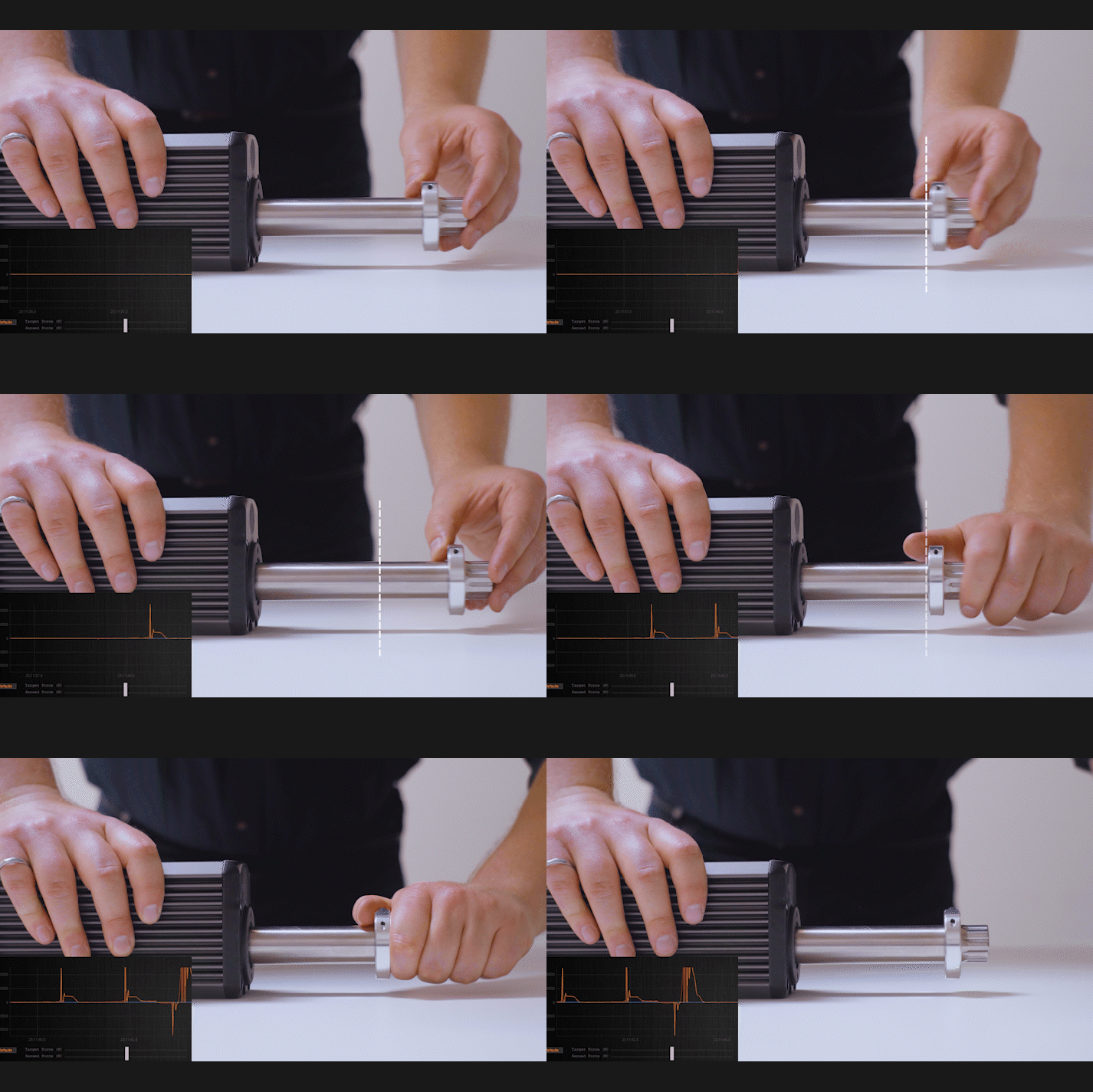
Vibration feedback uses rapid, repeating movements to create a buzzing sensation on the surface of the skin. The most common example of vibration feedback is in simple notifications or alerts. This type of feedback is fundamentally one-sided, in the regard that the motor sends a preset signal to the operator, but it cannot respond or push back based on how hard the operator pushes against it.
Force Feedback
Force feedback uses closed-loop, real-time force control to simulate physical behaviours such as springs, damping, inertia, and constant forces, as well as oscillations, pulses, and vibrations. These effects can be layered to create custom force profiles for interactive and automated applications. The ORCA motor's long stroke enables these effects across an extended range of motion, combining broad movement with fine tactile detail. This feedback feels like true physical resistance that the user can touch and feel, giving operators physical control and complete immersion.
Why Vibration Alone Isn't Enough
Vibration feedback alone is incapable of recreating the nuanced, complex sensations required for true physical simulation. Because vibrotactile effects rely purely on surface-level buzzing, they are constrained by inherent sensory limits. A vibration effect in a linear motor can alert a user, but it cannot simulate structural stiffness, fluid resistance, weight distribution, or hard mechanical stops.
When a user pushes against a virtual wall or operates a remote robotic arm, simple vibrations fail to convey critical spatial and physical boundary data. Force feedback dynamically responds based on position, speed, and time, going far beyond simple resistance through use input. By operating in true force-feedback modes, these haptic effects bridge the gap by engaging the full sense of touch, turning two-dimensional interactions into tangible physical realities.
What is a Force Controlled Motor?
A force controller regulates the current supplied to its windings to produce a known force. Rather than targeting a specific position or speed, it controls the force applied. Combining high-speed force rendering with precise position sensing, these motors deliver high dynamic response, allowing them to instantly switch between active pushing or pulling and micro-vibrations. They are further distinguished by their back-drivability: because there are no internal gears, movement remains completely smooth, allowing users to push back against the motor naturally and experience clean, organized resistance rather than mechanical friction.
Bringing this technology into practical application, the ORCA motor combines the motor, controller, driver, and force and position sensors directly inside a single compact housing. By eliminating the need for external load cells or bulky driver boards, the ORCA motor enables high-speed, low-latency force control, allowing it to reproduce precise haptic effects such as high-frequency vibrations and realistic virtual hard stops. With low-voltage DC operation and integrated control, the ORCA motor simplifies the implementation of high-precision haptics.
Programmable Haptic Effects with ORCA™ Motors
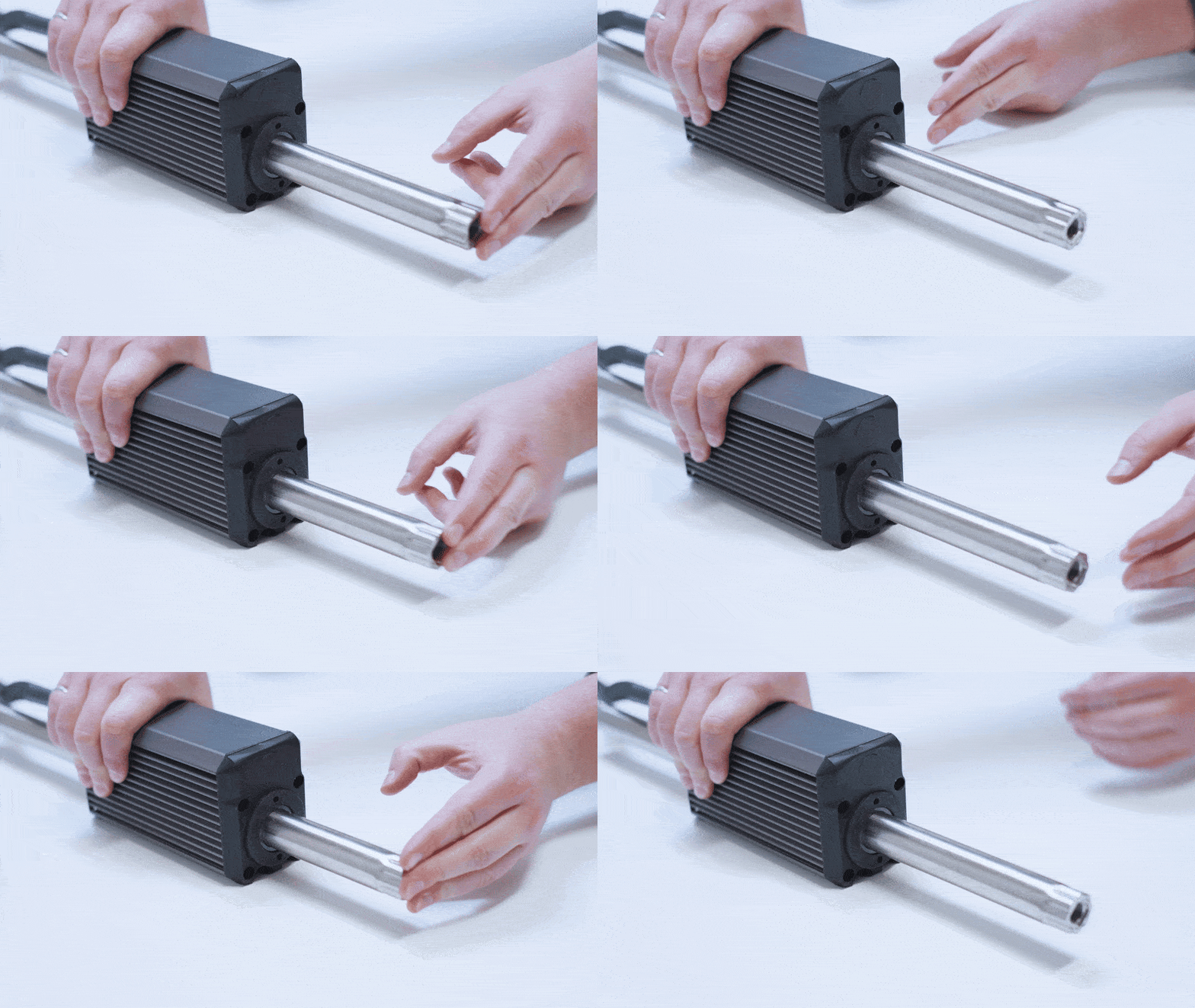
Rather than relying on fixed mechanical components like physical springs, hydraulic dampers, or flywheels, ORCA motors simulate real-world physics by calculating dynamic force vectors natively on the drive. By continuously measuring position and velocity, the motor applied calculated force in real time, recreating spring forces, viscous drag, mass momentum, or tactile surface patterns. Combining macro baseline forces with high-frequency vibration enables multi-layered physical sensations along a single linear axis.
ORCA motors support a haptic mode with a number of effects that can be combined or toggled dynamically in software:
| Haptic Effect | Effects & Behaviour | Practical Application Example |
| Constant Force | Delivers a uniform, continuous push or pull regardless of position or velocity | Constant force application on frames to measure resulting deflections |
| Spring | Generates resistance proportional to displacement from a centre point | Centering flight control sticks or simulating mechanical return springs; can be used to create soft stops and virtual walls. |
| Damper | Applies resistance proportional to speed (resists rapid movements while allowing slow, smooth motion) | Dynamic seat dampening in operator cabs, active shock absorption, or isolation system testing; fine-tuning stiffness and damping criteria to remove oscillations |
| Inertia | Simulates mass momentum, causing the control to resist initial acceleration and coast slightly when released | Makes a simulator's sliding control feel like it is moving a heavy assembly, or reproduces the resistance of a loaded carriage on a test rig |
| Oscillators | Creates a period force, such as pulse, sine, triangle, or sawtooth waveform |
Fatigue testing utilizing force oscillators |
Putting Haptic Controls into Practice
By combining real-time force sensing with dynamic motion control, programmable linear motors bring physical intelligence to critical industrial, medical, and commercial applications. In automated logistics and manufacturing, force-controlled linear motors act as both actuators and inline inspection tools. On high-speed conveyor lines, an ORCA motor can use real-time force sensing and dynamic thrust to divert packages without crushing delicate items, instantly detecting subtle variations in item mass or resistance to adjust its push force on the fly.
In heavy equipment for mining, agriculture, and construction, operators are routinely exposed to harsh cabin shocks, chassis vibrations, and rough terrain bounce. By applying dynamic damping algorithms, haptic linear motors absorb high-impact forces in real time. Programmatically adjusting seat stiffness to match terrain conditions significantly reduces operator fatigue and long-term spinal injury, turning violent mechanical motion into smooth, controlled support.
High-stakes motion platforms demand instant, bidirectional force adjustments to protect delicate payloads or human life. Active stabilization systems rely on haptic motors to recreate or actively cancel motion forces as they occur. The same core technology scales seamlessly into flight simulators, surgical robotics, and remote teleoperation controls where capabilities like force linking allow operators to feel and respond to forces experienced by a remotely controlled system.
Haptics Enable Responsive, Programmable Force Feedback
True haptic feedback extends far beyond basic vibration, unlocking realistic, full-spectrum physical interaction through closed-loop force feedback. By combining programmable forces, active damping, and fine vibrations into a single fully integrated actuator, ORCA motors minimize latency through onboard control, enabling highly responsive haptic feedback without external control hardware.
