
PLC Communication Protocols for Multi-Vendor Integration and Smart Linear Motor Control in Industry 4.0
By linking hardware and databases through the Industrial Internet of Things (IIoT), device connectivity has transitioned from an optional feature into an essential industry standard that actively reduces integration complexity. While previous industrial revolutions focused on replacing physical labour with mechanized manufacturing, electrical innovations, and computer electronics, Industry 4.0 centres on device connectivity.

Reliable communication between devices: PLCs, drivers, sensors, and actuators, is now just as critical as the hardware itself. Industrial operations require a highly sophisticated network, and because of the demand for sophistication and reliability, Industrial Ethernet has become the preferred communication protocol across advanced manufacturing and precision factory floors where instant data exchange, repeatability, and interconnectivity are non-negotiable.
What is Industrial Ethernet?
To understand its role on the factory floor, Table 1 illustrates how EtherNet/IP differs from consumer-grade IT networks.
| Industrial Ethernet | Commercial Ethernet |
| Extruded Jacket | Tubed Jacket |
| Significant Jacket Wall | Low Strand Count |
| High Flex Rated (up to 10 million cycles) | Static Install Only |
| Industrial Temperature Range (-40°C to +80°C) | Office Temperature Range (around 30°C) |
| Sunlight, UV, Oil, Ozone, Moisture, and Weld Splatter Resistance) | No Resistance |
| Industrial Approvals: UL, CSA for Communication, 600 V Rating, Tray Ratings, Shipboard or Rail Approvals) | No Approvals |
| Tinned Copper | Bare Copper |
Table 1. Source: turck
Industrial Ethernet leverages standard Ethernet technology to provide deterministic, high-speed, and reliable communication between devices. Engineered to withstand harsh environments, this hardware can operate reliably in extreme temperatures ranging from below -40°C to over 80°C, making it ideal for integration into complex remote machinery. Industrial Ethernet features robust resistance to UV rays and harsh chemicals like industrial oils, ensuring peak performance in demanding environments from offshore marine applications to arid deserts.
As machine builders' needs evolve, Iris Dynamics continues to adapt, releasing our newest product: ORCA-EIP™. This device bridges the gap between operational and information technology by directly connecting motors to controllers over an EtherNet/IP network. ORCA-EIP is ideal for high-precision industrial applications, including test and measurement, OEM machine building, press-and-insertion, and sort-and-rejecting systems. Ultimately, the ORCA-EIP is designed to adapt to its environment, ensuring the infrastructure never has to adapt to it.
Industrial Ethernet Protocol Comparison Table
When designing a modern control system, engineers frequently run network comparisons like PROFINET vs EtherNet/IP to determine the right standard for their hardware. Understanding these differences - such as the operation nuances of PROFINET, comparing legacy systems like Modbus, weighing latency, or assessing performance - is vital.
EtherNet/IP vs PROFINET vs EtherCat vs ModbusTCP: Which Protocol is Right for You?
| Protocol | Description | Typical PLC Vendors | Region of Use | Global Marketshare Percentage |
| PROFINET | Industry technical standard for data communication over Industrial Ethernet |
Siemens Phoenix Contact Beckhoff Automation |
Europe China |
30% |
| EtherNet/IP | Protocol that adapts CIP to standard Ethernet | Rockwell Automation (Allen-Bradley) Omron Schneider Electric |
North America | 25% |
| EtherCat | Ethernet-based fieldbus system |
Beckhoff Automation Omron Bosch Rexroth |
Asia-Pacific Region | 20% |
| ModbusTCP | Industrial computer networking protocol |
Schneider Electric Siemens Omron |
Globally: Europe North America |
5% |
Questions to Ask Before Selecting an Industrial Ethernet Protocol
-
Which PLC platform is being used in the application?
- Does the application rely on multi-vendor hardware?
- Is deterministic motion required?
- Will the application need future expansion?
- What level of diagnostics is expected?
- What is the cycle time requirement?
- Will this application communicate with MES or SCADA?
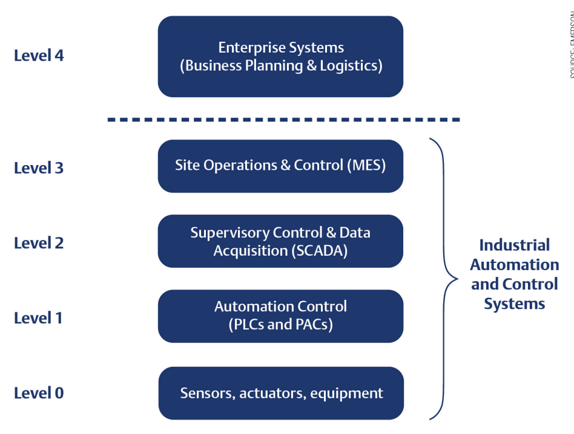
Figure 2. Source: Emerson
Industrial Ethernet Market Share and Adoption Reaches 79%
HMS Networks conducts an annual field study to track the communication protocols machine builders use in their factories as seen in Figure 3. As of 2026, Industrial Ethernet has decisively overtaken all other protocols, securing a 79% share of new installations. This represents a 45% increase since 2015, proving its rapid adoption.
Because modern multi-vendor production lines require seamless, standardized communication, EtherNet/IP has become the preferred choice to meet plant-wide network demands. Offering simplified predictive maintenance, remote diagnostics, and a durable architecture engineered to withstand harsh operating environments, the protocol actively reduces network downtime and data loss to maximize cost savings. At the same time, integrating Power over Ethernet (PoE) functionality dramatically cuts down on overall cabling and hardware costs.
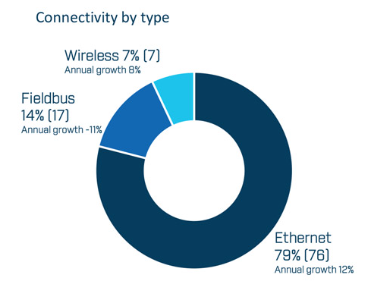
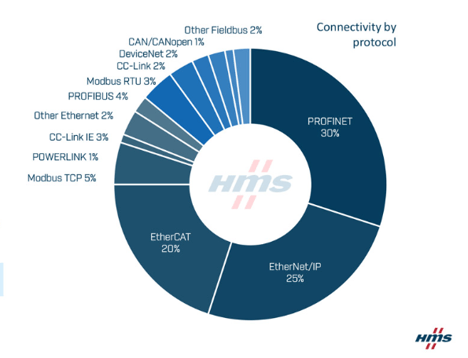
Figure 3: HMS
Industrial Ethernet Across Automation Roles
Different audiences adopt Industrial Ethernet for different reasons. While project needs vary depending on the application, Industrial Ethernet simplifies operations. The table below outlines how these benefits align with different operation roles:
| Audience | Common Challenges | Industrial Ethernet Advantages |
| Machine Builders |
|
|
| System Integrators |
|
|
| Manufacturers/End Users |
|
|
| Control Engineers |
|
|
Simplifying Rockwell PLC Integration with ORCA-EIP
-Jul-16-2026-11-03-30-2779-PM.png?width=331&height=263&name=Untitled%20design%20(1)-Jul-16-2026-11-03-30-2779-PM.png) Programmable Logic Controller (PLC) selection is one of the most critical decisions a machine builder will make. Rockwell Automation platforms are the most widely utilized PLCs in North America. Enter Iris Dynamics' ORCA-EIP: a deterministic Industrial Ethernet motor interface built exclusively for ORCA™ Series Smart Linear Motors to natively support the EtherNet/IP protocol.
Programmable Logic Controller (PLC) selection is one of the most critical decisions a machine builder will make. Rockwell Automation platforms are the most widely utilized PLCs in North America. Enter Iris Dynamics' ORCA-EIP: a deterministic Industrial Ethernet motor interface built exclusively for ORCA™ Series Smart Linear Motors to natively support the EtherNet/IP protocol.
The ORCA-EIP enables deterministic, synchronized multi-axis control, allowing ORCA motors to integrate seamlessly into PLC-based automation architectures.
To deliver true out of the box commissioning experience, the ORCA-EIP leverages EtherNet/IP Forward Open mechanism. During this initial connection between PLC and the ORCA-EIP, the configuration assembly is transmitted automatically. This allows users to configure critical motor parameters directly from their PLC environment without manual programming. Upon connection, the PLC automatically configures essential settings, such as Auto Zero, force and speed, PID tuning, safety damping, and safety limits.
Unlike generic motion gateways, the ORCA-EIP is optimized specifically for ORCA motor communication architecture and data throughput. By tightly coupling Industrial Ethernet synchronization with high-bandwidth motor communication, it delivers predictable, scalable performance in demanding industrial environments.
Typical ORCA-EIP Architecture
Enterprise
ERP
│
Manufacturing Operations
MES
│
Supervisory Control
SCADA
│
Control
PLC
│
Industrial Ethernet Network
Managed Switch
├── ORCA-EIP → ORCA Motors
├── VFD
├── HMI
├── Remote I/O
└── Robot
Final Thoughts
As technology evolves faster than ever before, traditional industry standards must adapt. To keep pace with this rapidly changing landscape, one of the most critical decisions a machine builder will make is choosing which Industrial Ethernet protocol to implement in their equipment.
